
By Tim Kelley
AW Safety Chairman
Paul Zirkelbach's recent death hit very close to home (see AmericanWhitewater.org/Forum/AW/192718). Paul had taken me down my first class V run 18 years ago, and just three weeks before his death we had a great day on a class V+ run below the section of river he died on. I marveled at this 50 yr-old's grace and skill. Twelve years my senior, he was still my hero. We joked about him being a member of the "old-bold" kayakers' club, which has only a few members running CL V+ at age 50. Paul gave one of his patented smiles and said, "I still have class VI at age 60 to look forward to." I didn't doubt him for a second. He had a spirit that seemed stronger than when I met him two decades before.
I have talked at length with those who paddled with Paul on the day of the accident. They are my regular paddling partners, and it goes without saying some of my closest friends. There is no rocket science needed to determine what may have prevented the accident. Paul knew what he was doing when he chose to run the drop without safety. He had consciously given up any margin for error that existed, if any existed at all, but that was Paul. Paul's willingness to "hang it out" and his uncanny ability to escape disaster was legendary. Everyone paddling with the group knew and accepted the heightened risk that paddling with Paul represented. Just last year he was pinned while attempting a first descent of the Miran River in Peru. He broke his kneecap and almost drowned before Ethan Greene and others rescued him. Paul, better than most, understood the dangers of the sport.
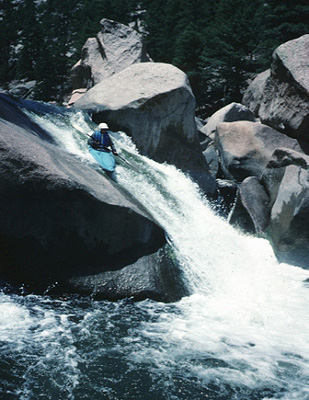
No one knows why Paul made his decision to run "The Gash" the way he did. He didn't run the drop for "cameras", not for "sponsorship" and certainly not to uphold his "reputation". Like many of us, Paul thrived on how alive running difficult drops made him feel, whether around the world or in his backyard. I believe Paul ran that drop for the purest of motives... because it was there and he felt he could nail the move. What remains to be considered... judged, is our own motives and decision-making process.
Running difficult whitewater is based on personal decisions, and I hope it never becomes one regulated by "mother hens". With personal decisions come personal responsibility to have the skills and experience necessary to make those decisions. When we make a decision to paddle something we are not only exposing ourselves to risks, but also those who will try to rescue us. Paul knew the group he was paddling with had the skills, equipment, and judgment to attempt a "safe" rescue; that they would do whatever they could, but do it as safely as possible. Let's look a little closer at the subtle lessons practiced and reinforced in this rescue attempt.
First, I don't believe there really is such a thing as a "safe" rescue. The key then is making the rescue attempt as safe as possible. Take a minute to reflect and imagine attempting such a rescue. Could you and your group keep this type of rescue attempt "safe"? Consider the following points:
Make sure you can do everything possible to rescue a friend "safely" if a similar situation occurs in your group, and remember the following simple guidelines:
As I watched Paul's ashes float down Bailey Canyon and tears rolled down my cheeks, I wasn't asking Paul why he didn't wait for safety. Instead I was wrestling with my own decision-making with respect to rapids I had run and walked in the past. Had I considered the safety of those that might have to rescue me, enough? Don't wait until you're watching a close friend's ashes float away forever to think about these things. Consider the affect that your personal decisions have on your paddling buddies.
I'll miss paddling with Paul, and will think of him often. I know Paul is smiling above telling us to get over it! Go paddle!
Vios con dios mi amigo…
AW Safety Chairman
Paul Zirkelbach's recent death hit very close to home (see AmericanWhitewater.org/Forum/AW/192718). Paul had taken me down my first class V run 18 years ago, and just three weeks before his death we had a great day on a class V+ run below the section of river he died on. I marveled at this 50 yr-old's grace and skill. Twelve years my senior, he was still my hero. We joked about him being a member of the "old-bold" kayakers' club, which has only a few members running CL V+ at age 50. Paul gave one of his patented smiles and said, "I still have class VI at age 60 to look forward to." I didn't doubt him for a second. He had a spirit that seemed stronger than when I met him two decades before.
I have talked at length with those who paddled with Paul on the day of the accident. They are my regular paddling partners, and it goes without saying some of my closest friends. There is no rocket science needed to determine what may have prevented the accident. Paul knew what he was doing when he chose to run the drop without safety. He had consciously given up any margin for error that existed, if any existed at all, but that was Paul. Paul's willingness to "hang it out" and his uncanny ability to escape disaster was legendary. Everyone paddling with the group knew and accepted the heightened risk that paddling with Paul represented. Just last year he was pinned while attempting a first descent of the Miran River in Peru. He broke his kneecap and almost drowned before Ethan Greene and others rescued him. Paul, better than most, understood the dangers of the sport.
"You're livin' our dreams, wo you on top
My mind is achin', Lord it won't stop
That's how it happens livin' life by the drop…"
(D. Branhall - B. Logan)
My mind is achin', Lord it won't stop
That's how it happens livin' life by the drop…"
(D. Branhall - B. Logan)
No one knows why Paul made his decision to run "The Gash" the way he did. He didn't run the drop for "cameras", not for "sponsorship" and certainly not to uphold his "reputation". Like many of us, Paul thrived on how alive running difficult drops made him feel, whether around the world or in his backyard. I believe Paul ran that drop for the purest of motives... because it was there and he felt he could nail the move. What remains to be considered... judged, is our own motives and decision-making process.
Running difficult whitewater is based on personal decisions, and I hope it never becomes one regulated by "mother hens". With personal decisions come personal responsibility to have the skills and experience necessary to make those decisions. When we make a decision to paddle something we are not only exposing ourselves to risks, but also those who will try to rescue us. Paul knew the group he was paddling with had the skills, equipment, and judgment to attempt a "safe" rescue; that they would do whatever they could, but do it as safely as possible. Let's look a little closer at the subtle lessons practiced and reinforced in this rescue attempt.
First, I don't believe there really is such a thing as a "safe" rescue. The key then is making the rescue attempt as safe as possible. Take a minute to reflect and imagine attempting such a rescue. Could you and your group keep this type of rescue attempt "safe"? Consider the following points:
The intangible in this rescue attempt and body recovery, like most, was the group's ability to watch each other's "back" both physically and emotionally. It is refreshing to know that the guys I paddle with did all they could to try and save Paul "safely". That simple statement does little to recognize the high risk these guys were exposed to, but having read the accident report I'm sure you get the picture.
- Rescue Whistle: This was a very narrow creek yet the noise of the drop made good rescue whistles essential. Do you carry one? I recommend an orange Fox 40. It is small, loud, and durable. Spend the few dollars to have one, and attach it to your life jacket.
- Carabiner to Clip Large Grab Loops: Make sure the 'biner used to attach the rope to the boat's grab loop is big enough. Many of today's boats have hard plastic grab loops that are relatively thick. They are strong and easy to clip, but only with large "parabiners" or similar designs. Does your carabiner clip the boats in your group? Does your buddy's biner work on your boat?
- Dress for a Swim or Rescue: This was a snowmelt creek on a very hot day. The rescue attempt required prolonged exposure in cold water. Do you dress warm enough to stand in snowmelt for 20 minutes attempting to save your friend's life? If you get hot paddling, it is certainly easy enough to cool off. Dress for a swim or rescue, rather than for the comfort of a clean run.
- Proper Footwear: Good river shoes made scaling cliffs and searching down river possible as well as belaying those searching for Paul in the river. Simple booties don't cut it.
- Waist Throwbags: Waist throwbags were a great asset to those who scaled cliffs and searched down river from the banks. Do you have one?
- PFD Rescue Harness: A rescue harness was critical to everyone in the group at some time. Do you and the people you paddle with have the skill and equipment to "live-bait" someone into the "maw" of the kind of rapids you run? Have you ever practiced using your rescue vest?
- Safety Boater below the drop: The "slack" water after this drop didn't require having a safety boater in the water below the rapid to catch either the victim or a rescuer that may get into trouble, but it is something you should always consider.
- Efficient Organization: The group made full use of all "witnesses", greatly increasing the rescue attempt's efficiency. Be careful however, especially when using hikers and fishermen who aren't wearing PFD's, or don't have other personal safety gear. Be sure everyone wears all the safety gear they have.
- Volunteer Rescue Squads: The evacuation of the body made clear that the volunteer rescue squads that responded were not experienced in dealing with CL IV or V whitewater. The kayakers made sure the rescue squads remained safe. This would have been much more difficult if the body would have still been missing when the rescue squads arrived. It is too often reported how inexperienced rescue squads have tragically killed their own doing swiftwater body recoveries. It is worthwhile to make contact and work with your local rescue squads before such accidents happen in order to improve relations before exposing both sides to the strengths and weaknesses of each other.
Make sure you can do everything possible to rescue a friend "safely" if a similar situation occurs in your group, and remember the following simple guidelines:
- Wear the right clothing and shoes.
- Carry and know how to use the appropriate safety equipment (always carry a rope and a whistle).
- Control the situation never letting emotions dictate unsafe decisions or acts.
- Realize when a rescue becomes a body recovery.
- Realize how your personal decision to run a drop can risk the lives of others.
As I watched Paul's ashes float down Bailey Canyon and tears rolled down my cheeks, I wasn't asking Paul why he didn't wait for safety. Instead I was wrestling with my own decision-making with respect to rapids I had run and walked in the past. Had I considered the safety of those that might have to rescue me, enough? Don't wait until you're watching a close friend's ashes float away forever to think about these things. Consider the affect that your personal decisions have on your paddling buddies.
I'll miss paddling with Paul, and will think of him often. I know Paul is smiling above telling us to get over it! Go paddle!
"We're livin' our dreams
My mind's stopped achin'
That's how it happens livin' life by the drop."
(D. Branhall - B. Logan)
My mind's stopped achin'
That's how it happens livin' life by the drop."
(D. Branhall - B. Logan)
Vios con dios mi amigo…