
FERC to Host Public Catawba Meetings
-
Upper Watershed: Downstream of Lake James lies a dam release class II whitewater run followed by a longer Class I float trip. The river flows through a forested riparian area and offers an excellent summer boating resource for beginner and intermediate boaters. As a result of the agreement: paddlers and anglers will have 85 days annually on which they will have scheduled and predictable releases at desirable flows, 695 acres of riparian corridor will be protected from development, several new river access areas will be built (including a portage around a dangerous weir), public flow information will be improved, and money will be made available for additional habitat conservation activities. For a more detailed summary: http://www.dukepower.com/lakes/cw/summaries/james.pdf. In addition a gage is being installed on Wilson Creek and 2,800 acres of land is already being protected along the Johns River as a result of the agreement (see release below)! Unlike other NC gamelands managed purely for hunting and fishing, all lands protected under the Catawba agreement will support open space, public access, trails, camping, and other public recreational uses.
-
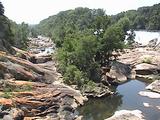
Great Falls of the Catawba: The remnants of the Great Falls of the Catawba have been dewatered since 1907, but the agreement calls for the river to begin flowing continuously. The falls are actually class II-III rapids featuring some epic play waves, a beautiful and protected river corridor, interesting geology, and a lowland ecosystem uncommon among whitewater rivers. As a result of the agreement the Falls will have a new base flow every moment of every day, as well as 22 days of scheduled boating flows on the long channel and 28 days on the short channel. The Falls area will also be getting a new state park, significant land conservation, several river access areas, and new flow information. We hope that all this will revitalize the Town of Great Falls, which have been great to work with on this issue. For a more detailed summary: http://www.dukepower.com/lakes/cw/summaries/gf_rocky_creek.pdf In addition to these two reaches, additional recreational and environmental enhancements will be provided throughout the basin. For more information on these areas, or to read the agreement AW signed: http://www.dukepower.com/lakes/cw/summaries.asp
-
For More Information on the Settlement Agreement and the Catawba: http://www.americanwhitewater.org/content/Project/view/id/27/
-
Identify yourself as a whitewater paddler, and let FERC know if you are an AW or CCC member.
-
Voice support for the Settlement Agreement. This is very important.
-
Share your enthusiasm for improved river access and flows throughout the watershed, especially in the Great Falls of the Catawba and the Bridgewater section.
-
Talk about how the proposed changes will benefit you and your community of friends. Just be yourself! Share why you want epic playboating, scenic float trips, and protected river corridors right in your back yard???
-
Offer any information or concerns you have regarding the project.
Morganton, NC
828-433-4067
Mooresville, NC
704.662.3334
Rock Hill, SC
803-981-7100
Camden, SC
803-432-7335
Duke Hydro-Relicensing Agreement Supports Land Deal
Johns-Catawba River Confluence Lands Protected
MORGANTON, N.C. – Approximately 2,800 acres at the confluence of the Johns and Catawba rivers in Burke County were added yesterday to the N. C. Wildlife Resources Commission’s game lands program, protecting a unique wetlands and riverine system.
The acquisition also marks the first conservation transaction supported by Duke Energy’s recent Catawba-Wateree comprehensive hydro-relicensing agreement.
Foothills Conservancy of North Carolina negotiated the purchase of the land for $11.5 million from Crescent Resources on behalf of the Wildlife Resources Commission.
“Today’s acquisition protects outstanding ecosystems of the lower Johns River and brings these special river lands and habitats under public stewardship,” said Tom Kenney, Foothills Conservancy’s land protection director. “It also represents a major first step toward implementing the Catawba-Wateree river conservation goals embodied in Duke’s relicensing agreement with stakeholders including Foothills Conservancy and Wildlife Resources.”
“Crescent Resources has been privileged to manage this property for more than three decades,” said Jim Short, senior vice president of Crescent Resources. “Foothills Conservancy, Clean Water Management Trust Fund and the Wildlife Resources Commission are to be commended for their commitment to share this property’s natural beauty, waters and wildlife with the public.”
Foothills Conservancy and the Wildlife Resources Commission obtained funding for the acquisition from a number of sources. The N. C. Clean Water Management Trust Fund granted Foothills Conservancy $5,235,000 to acquire the land’s wetlands and riparian areas. The hydro-relicensing agreement provided for a reduction in purchase price of approximately $2.5 million. The remaining $3.8 million required for the purchase was contributed by Duke Energy as part of the relicensing agreement for land acquisition support.
“This is indeed a significant milestone, and it’s wonderful to see the results of the collaborative efforts of stakeholders for the benefit of the environment and the public,” stated Ellen Ruff, president, Duke Energy Carolinas. “Duke Energy is pleased to contribute to this effort. It’s a win-win in all aspects.”
“Duke Energy’s willingness to support land acquisitions outside of the hydropower project boundary was key to resolving the very complex hydropower negotiations,” said Chris Goudreau, hydropower licensing coordinator with the North Carolina Wildlife Resources Commission.
The land acquired from Crescent Resources includes 17 miles along both sides of the Johns River and Lower Creek downstream of N.C. Highway 18, as well as Catawba River-Lake Rhodhiss frontage. Adjoined by 1,000 acres upstream on the Johns River, acquired in November 2006 by the Wildlife Commission with support from Ducks Unlimited and the N.C. Natural Heritage Program, the Johns River Game Land represents one of western North Carolina’s most significant land and water conservation areas.
“The Wildlife Commission now owns one of the largest and most extensive habitats for waterfowl and other species that depend on flooded ecosystems in western North Carolina,” stated Gordon Warburton, supervising wildlife biologist with the Wildlife Resources Commission. “This area is truly a ‘crown jewel’ for wildlife and will be a great place for sportsmen and the public to see a unique assemblage of wildlife species.”
The Johns River acquisition will not become an official game land that is open to sportsmen until July 1, 2008. The deadline to enact regulations for this fall has already passed.
The confluence of the Johns River with the Catawba hosts rich bottomland habitats and extensive forested floodplains which are rare in the foothills and mountains. Wetlands lace the land, enhancing the water quality of Lower Creek and the Johns River and attracting migratory waterfowl and a wide variety of animals and aquatic life. Designated as High Quality Waters and as a Significant Aquatic Habitat, the Johns River lands are also home to the federally threatened bog turtle. An important section of the Overmountain Victory National Historic Trail crosses the land, adding historical significance to the purchase.
“Acquisition of this land was critical to protecting the relatively unpolluted waters of the Johns River and its tributaries,” said Rance Henderson, a Clean Water Management Trust Fund trustee and Burke County resident. “It also will help protect drinking water supplies for people downstream in the Catawba Basin, beginning with the city of Valdese. The Clean Water Management Trust Fund is proud to have participated in this project and to have invested more than $67 million to date in the Catawba River Basin.”
“Protection of these vital Catawba Basin waters and this special river landscape would not have been possible without the Clean Water Management Trust Fund’s early commitment of support,” said Susie Hamrick Jones, Foothills Conservancy’s executive director. “We extend a special thank you to Clean Water and to Crescent Resources and Duke Energy Carolinas for working with Foothills Conservancy and the Wildlife Resources Commission to find a way to secure these lands through the relicensing agreement.”
More information about Foothills Conservancy’s Catawba River Basin protection projects and other conservation efforts in the Blue Ridge Foothills can be found on-line at www.foothillsconservancy.org or by calling 828-437-9930.
For more information on the N.C. Wildlife Resources Commission and its network of wildlife lands throughout the state, go on-line to www.ncwildlife.org.