
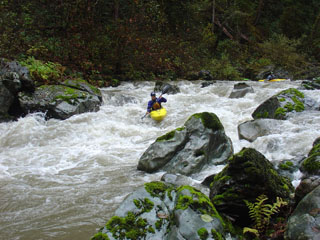
AW Reaches Agreement on Sultan River (WA)
American Whitewater has reached agreement with Snohomish PUD and other parties to the relicensing
of the Jackson Hydropower Project on the Sultan River. The future proposed license will support
whitewater boating on the Sultan River and in particular the reach between Culmback Dam and the
Powerhouse known as the Upper Sultan. The Settlement Agreement was signed earlier this month and
celebrated yesterday in a ceremony at the powerhouse. Over the coming year federal regulators
will review the agreement and we anticipate issuance of a new license in spring of 2011.
Whitewater flows will begin after that date.
This was a challenging agreement due to the fact that this is a highly profitable hydropower
project where nearly all the flow is diverted, the City of Everett depends on the river for their
municipal water needs, and fish listed under the Endangered Species Act utilize the river.
Folding whitewater recreation into a future license was extremely challenging but we appreciate
the efforts of all parties to take our issue seriously and negotiate in good faith.
The future license will include an average of 4 whitewater opportunities each year. This is
somewhat less than comparable runs of this quality that are in close proximity to a large boating
populations but a few factors went into our decision:
1) It is a long run with challenging access that is physically demanding. In surveying those who
have done the run we determined that it was the type of run where individuals would be less
likely to run the river multiple consecutive days.
2) The Skykomish is a drainage with a diversity of opportunities and while the Upper Sultan
provides one of the highest quality opportunities in the area, there are several opportunities
for doing other runs for those who might travel to the area for the Sultan (i.e. a trip on a
release weekend could include a run on the Sultan and another nearby river).
3) There are several demands for water on this project and we made a decision that the certainty
of settlement and opportunity for collaboration with the utility during implementation outweighed
the risk of going to federal regulators directly to ask for more. Doing so would have led to a
contentious proceeding and a certain delay in getting water in the river, less opportunity for
collaboration and communication with boaters and the utility, and no guarantee that more flows
would be provided.
4) Working with other parties in a settlement context offered opportunities to combine our
interests with others which will lead to some opportunities every few years for high water
events. During whitewater studies the overall preference was for flows of approximately 1000 cfs
but several individuals expressed interest in lower technical flows around 600 cfs. Others had an
interest in high challenge trips at flows of 2000 cfs or more and the new license will include
provisions for these events which will occur as part of utility obligations to meet needs for
process flows.
5) Some provisions for access at the diversion dam will be provided along with an improved trail
to the put-in below Culmback Dam. In addition real-time data on reservoir elevation, improved
forecasting, and better communication between the utility and boaters will allow individuals to
more effectively take advantage of opportunities that will be provided during accretion flows
(during big rain events), spills, and project maintenance periods.
We spent considerable effort working with hydrologists from the Forest Service, Washington
Department of Fish and Wildlife, Washington Department of Ecology, and Tulalip Tribe to develop a
robust program of process flows that include channel maintenance and flushing flows that are also
compatible with whitewater boating opportunities. On too many projects we have worked on in the
past there is one very low minimum instream flow designed to meet the habitat needs of one life
cycle stage for one species of fish and another flow for whitewater recreation. This agreement
embraces an emerging trend that recognizes the need for a diversity of flows that can meet both
ecological and recreational needs. By working together we were able to develop a program that
meets a diversity of interests for fish, river health, and recreation that was well beyond what
any of us could have achieved by focusing on these different interests independently.
The Proposed License Article is copied below. Anyone with questions or feedback on this agreement
should contact American Whitewater. In the coming months we will be working with the utility to
develop a detailed whitewater plan that will spell out more specifics. It is critical that we
receive any feedback folks have before we launch into the details of plan development.
We wish to express our appreciation to Andy Bridge who has served as our key local volunteer on
this project and the folks at Werner Paddles who have provided opportunities for Andy to
participate in this process. We also thank the more than two dozen volunteers who have
participated in flow studies, attended meetings, written letters, and provided us with feedback
during this process.
Proposed License Article: Whitewater Boating Flows (from the settlement agreement
which can be downloaded from FERC)
The Licensee shall provide flows for twelve (12) viable whitewater boating events every
three (3) years for the duration of the License with sufficient advance notice to whitewater
boaters. During each three-year period, the Licensee shall provide a firm water budget of
2,100 acre-feet of water (total, to be allocated over three (3) years) to ensure that twelve (12)
viable whitewater events occur. If the 2,100 acre-feet of water budget in combination
with controlled and uncontrolled flow releases (i.e. spill) and accretion flows is not
sufficient to achieve twelve (12) viable whitewater events during each three (3) year
period, the License shall provide a reserve budget of 1,200 acre-feet to ensure that such
events occur.
1. Whitewater Recreation Plan
Within ninety (90) days after issuance of the License, the Licensee shall file with the
Commission, for approval, a Whitewater Recreation Plan (WR Plan). This WR Plan shall
document how the Licensee shall implement a program to provide annual higher flows in the Sultan
River below Culmback Dam for whitewater boating for the duration of the License.
1.1 The WR Plan shall include the following provisions that describe: (1) the frequency,
magnitude, duration, and timing of each whitewater event during the first three-year
period and the mechanism for determining such parameters during subsequent years; (2)
operational, biological, and other constraints upon whitewater events; (3) the ongoing
involvement (including annual meetings) of the Aquatic Resource Committee (ARC) and American
Whitewater in implementing the Program; (4) the mechanism for timing whitewater events to
coincide with natural rainfall events or coordinate with Project generation or other License
Article obligations to achieve greater flow volumes in desired reaches or habitats; (5) mechanism
for notifying whitewater boating stakeholders of whitewater boating opportunities during
scheduled whitewater events and other high flow events within the Sultan River; (6) mechanism for
assessing the boaters’ satisfaction during whitewater events and impacts to aquatic and
terrestrial resources; (7) mechanism for recording the number of participants, safety incidents,
and costs; (8) the timing and other restrictions necessary to minimize impacts to aquatic
resources, to not exacerbate flood damage in the City of Sultan; (9) the method and schedule for
monitoring flow releases and water budget accounting pursuant to the Plan; (10) the waiver of
indemnity for participants in a scheduled flow release; and (11) the mechanism for providing and
restricting the whitewater boating stakeholder representatives shuttle vehicle access to Culmback
Dam and the Diversion Dam during scheduled whitewater events
1.2 The Licensee shall develop the WR Plan in consultation with the ARC, American Whitewater and
National Park Service (NPS). The Licensee shall allow a minimum of thirty (30) days for
members of the ARC, American Whitewater and NPS to comment and make recommendations before
submitting the WR Plan to the Commission. When filing the WR Plan with the Commission, the
Licensee shall include documentation of consultation, copies of comments and recommendations, and
specific descriptions of how comments and recommendations from the ARC, American Whitewater, and
NPS are accommodated by the WR Plan. If the Licensee does not adopt a recommendation, the
filing shall include the Licensee’s reasons based upon Project-specific information.
Upon Commission approval, the Licensee shall implement the WR Plan.
2. Whitewater Events
2.1 The twelve (12) whitewater events will be provided either as (1) scheduled events (section
2.3), or (2) viable unscheduled whitewater events (section 2.2).
2.2 Viable Unscheduled Whitewater Events: A viable unscheduled whitewater event is defined
as a calendar day (a) occurring between March 15 and November 30 or at times agreed to by the
Licensee and American Whitewater in consultation with the ARC, (b) with controlled and
uncontrolled flow releases (i.e. spill) and accretion flows between 600 and 2000 for at
least three (3) hours, (c) during a time of day that supports whitewater boating, at conditions
that allow access to the reach, and (d) with at least 48 hours notice.
2.3 Scheduled Whitewater Events: Each year, at a minimum two (2) of the whitewater events
will be scheduled at least two (2) weeks in advance and shall occur on weekends, with one (1)
occurring in September and one (1) occurring in April or May. Each event shall be between
600 cfs and 2000 cfs and at times of the day that support whitewater boating. If the
duration of a scheduled whitewater event is scheduled to be longer than three (3) daylight hours,
the event will be counted as two (2) events. For purposes of determining compliance, the
scheduled whitewater event’s magnitude and duration will be measured at the flow gage
immediately upstream of the City of Everett’s Diversion Dam at River Mile (RM)
9.8.
2.4 So long as the whitewater recreation flow occurs on the noticed day for the whitewater
event, the scheduled magnitude and duration of a whitewater event may be achieved through any
combination of controlled (including releases to achieve process flow components pursuant to A-LA
8) and uncontrolled flow releases (i.e. spill) and accretion flow. However, only
water (above scheduled minimum flows) released from Culmback Dam pursuant to a scheduled
whitewater recreation flow event and any downramping associated with such release (as required by
A-LA 5) shall be deducted from the 2,100 acre-feet water budget. If a portion of the 2,100
acre-feet water budget remains after the twelve (12) events have been provided, the balance of
the water budget is available for additional releases during that three (3) year
period.
2.5 So long as the whitewater recreation flow occurs on the scheduled day, the scheduled
magnitude and duration of a whitewater event may be achieved through any combination of
controlled (including releases to achieve process flow components pursuant to A-LA 8) and
uncontrolled flow releases (i.e. spill) and accretion flow. However, only water
released from Culmback Dam pursuant to a scheduled whitewater recreation flow event and any
downramping associated with such release (as required by A-LA 5) shall be deducted from the water
budget provided in section 1.1.
2.6 The Licensee shall consult with the ARC, NPS and American Whitewater on an annual basis to
determine if the WR program is providing a meaningful whitewater experience and if the program
should be modified, within the constraints of the water budget. The License in consultation
with the ARC and American Whitewater may request that the Commission temporarily suspend or
reduce the WR Program based upon lack of meaningful whitewater boating experience. In the
event that the program is temporarily suspended or reduced, the Licensee will consult annually
with the ARC, NPS and American Whitewater concerning whether the Program shall be
resumed.
3. Drought Events
During the course of a water year, if necessary, the Licensee in consultation with the ARC shall
develop a drought controlled flow release schedule for whitewater events when: (1) a drought
event resulting in advisory reductions in domestic water consumption (as described by the 2007
City of Everett’s Drought Response Plan as a Stage 1 response to a drought event ) is
occurring; (2) the whitewater events described in this LA require interim modification (including
postponing or reductions in flow magnitude) to manage water supply during periods of weather
related shortages; and (3) the drought release schedule shall not undermine the purposes of this
License Article. The Licensee shall notify the Commission and shall implement the drought
release schedule within seven (7) days of providing such notice, unless otherwise directed by the
Commission.
4. Reservation System
The Licensee shall develop a reservation system for the weekend whitewater events, a scheduled
water release may be canceled if less than six (6) whitewater boaters makes a reservation by 5:00
p.m. on the Thursday prior to the scheduled event. Any event cancelled due to insufficient
reservations shall be counted as if the event has occurred (with a proportional reduction from
the water budget provided in section 1.1), and the Licensee shall be under no obligation to
reschedule the whitewater event.
Thomas O'Keefe
3537 NE 87th St.
Seattle, WA 98115