Cumberland, Big South Fork
3. Station Camp to Blue Heron, KY (19 miles)
August 11, 2011
| Reporter | Dunn Family |
Boats: Dagger Animas and a Perception Swifty
A friend and I did an overnight trip starting out at Station Camp on 7/30/2011 and terminated at Blue Heron on 7/31/2011. We were treated to two hugely different flow rates: About 400 CFS on 7/30, and 4000 CFS on 7/31. On 7/30, we bumped some rocks prior to reaching Big Island on a couple of occasions. There was a ledge we went over, I didn’t read it quite right, and I got hung up at the top of the ledge. So closer to 400 cfs, there will be spots where you will hit some rocks. We were kind of bummed about the low level, but it was still a good float. We camped somewhere past Big Island, not far from Bear Creek. When looking for a campsite, pay attention to sections of the river where ledges exist along either side of the river bank, especially river right. They will be about ten feet above the waterline. Upon picking our campsite (river right), we discovered a trail that paralleled the river. I don’t how long it was, but I would assume that there are several good camp sites along this trail. Our campsite was great! We took the suggestion about hanging the food (take some rope with you).
Then, that night, the thunderstorms came……
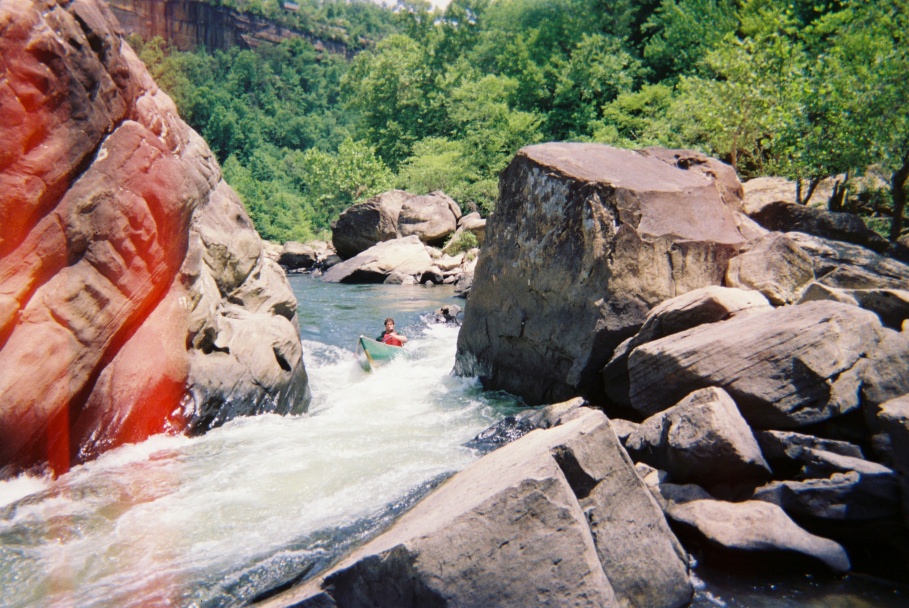
We didn’t know it, but by the time we set sail (about 11am), the flow was at 4000 CFS. All of the flat water was moving. We went through several wave trains that were class II, III. We probably would have been scraping in those the day before. The Animas handled the wave trains with no problem. This is a wide river, with lots of room to maneuver and lots of eddies at 4000 CFS. Had I not been using a spray skirt, this would have been a long (and dangerous) day. My buddy didn’t have a spray skirt, and his boat was swamped many times. At one point, his boat almost completely sank.
Some of the waves might have been bigger than class III. My friend told me that, at times, once I would get over a wave that I would completely disappear until I went through the next wave.
We saw folks in open canoes on the second day, and they were gun shy about going through these waves. I would have been as well. I think one group of them opted to get off the river and camp an extra night to allow time for the flow to drop.
There is mention of an observation deck in the 6/14/2003 posting that is high up the hillside on river right near Devil’s Jump. When looking for the river left take outs prior to Devil’s Jump, start looking river left when you are nearly perpendicular to this observation deck (which is on river right). The first take out is a very steep, tree root covered, soft sand hill with a length of about twenty feet. The second is less steep with more rocks to traverse. There is somewhat of a clearing at the second take out, and a very large V shaped tree close to the entrance. Miss this second take out, and you’re going to go over Devil’s Jump. I suggest that if you really want to miss Devils Jump, take out on river left where you see the first steep take out, climb up the bank, and turn right down the trail to scout the other take out. Then decide where you want to start your portage from.
We took the first take out because we didn’t know at that time that the second take out existed. Had we known about the second one, we would have taken it. We felt like we could have maneuvered to it, even with the high flow. Take your time with this portage, especially if you have a lot of gear. This portage is why I suggest that you should pack as light as possible.
We were off of the river at Blue Heron at about 5pm. We had spent some time during the day draining the Swifty, about an hour for lunch, and playing at Bear Creek for about an hour or so.
Check the other postings here for additional details of landmarks and such. Here are some other things I took from this trip:
1. Wear your PFD. Wear your PFD. Wear your PFD. We always do, and it probably saved my friends life at least once.
2. Before this trip, I had never put much thought into the term ‘wild river’. I get it now.
3. Pack light. This will make your portage around Devil’s Jump less painful (not pain free).
4. On this river, a spray skirt is your friend.
5. The second day for us was really intense, but much more fun. We’re used to class I and II. I would take 4000 cfs over 400 cfs on that section any day. On the second day, were more comfortable after the first three wave trains. It was a good test for us. We were definitely out of our comfort zone at 4000 cfs. I think the lower flow rate (400 CFS) was actually higher than normal for late July.
6. If you’re used to class I & II, and are taking a rec boat, try to allow for an extra day if possible, especially if there is a good chance for decent rain. You might need it.
7. Get a good look at the take out at Blue Heron before you start the trip. It’s almost right after Devil’s Jump on river right, and marked by a somewhat washed out concrete boat ramp.
8. I wouldn’t recommend floating this section below 500 cfs.
9. Bring along a hatch cover. I didn’t, and I had a lot of spiders in the boat on the morning of the second day. Once I was back on the water, I found out quick that I didn’t get them all out.
10. We brought a water pump, and carried very little water. There are a number of small cascades along this section on the river bank where you can collect clear water (the river was muddy on our trip).
11. We found the fishing at this time of year to not be so great. The water was warm and muddy. I had a collapsible fishing rod with me. These are very easy to camp/float with.
12. Both of our wives being out of town (with the kids) at the same time made this trip possible for us. You can chuckle now.
We had a great time, and we can’t wait to go back!