Ocoee
Upper Ocoee - Ocoee #3 to Ocoee #2 Dam(Upper Whitewater Section and Olympic Course)
January 1, 1900
| Reporter | Ken Strickland |
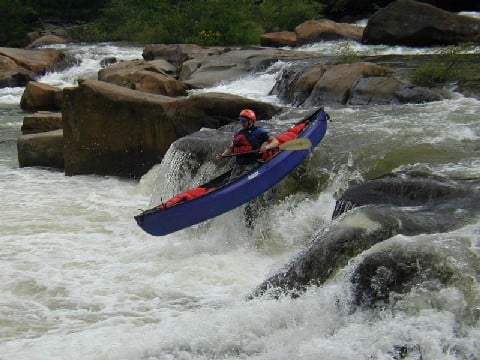
Boaters need to be aware of this hazard located slightly upstream of the actual 'boof' line. If one is on line and charging for the 'boof,' the boater will pass almost directly over the sieve which will be at an approximate depth of three feet underneath the water at normal release levels. However, this is not a place to be out of one's craft (scouting or swimming). This photo was taken from downstream and to the river-right side of the sieve.
This is the standard boof line as seen from the river left shore. The sieve is located in the dark area underneath and approximately 1/4 up the white arrow from the right side of the photo. At normal levels the sieve should not be an issue so long as one is in his boat, in control, and going for the boof (the approach is in moving flatwater). However, for a swimmer or someone attempting the line at a low flow, it is a lethal hazard.
The standard boof line will pass almost directly over the sieve which is located in the flatwater approach to the actual boof. At normal release levels (1400cfs) the sieve opening will be approximately 3 1/2 feet under the surface and should not be an issue. However, at lower flows or if someone were swimming, it would certainly be a hazard.
This is the view of the sieve opening from within the grotto. Below the opening the sieve widens considerably and has an irregular depth of from four to seven feet. The water filters out through several small passages and one large opening in the river left wall.
A large opening exists in the river left wall of the grotto. The large bedrock slab seen in the sunshine is the one where boaters often take out and carry back up for another run of the boof, or carry back up and ferry across the river for a run of Mikey's Ledge. Whether or not this exit could be found when the grotto is full of turbulent water is an unknown.
Strange light patterns dance on the stone walls inside the grotto.
The 'Blue Hole' is actually a swimming hole located at the run-out of the long rapid above the 1996 Olympic Bridge (this rapid has been known to some of us as 'The Gauntlet' since the late 70s). The name 'Blue Hole' comes from the delightful experience of submerging oneself into the bottom of one of the nearby connected potholes and gazing up through the clear water at the blue sky framed by the pothole's opening. Goggles or a face mask help!
An underwater view of a pothole skylight taken from the grotto of an adjoining pothole.