Catawba
Great Falls Short Channel(Great Falls)
February 1, 2022
| Reporter | Logan Phillips |
| Gauge Reading | 0.45 cfs |
Beta on this run is very, very limited, so hopefully this helps to start adding to the public knowledge of this run. Lots of dead wood due to the fact that flow to this area has been restricted for 110 years so be careful.
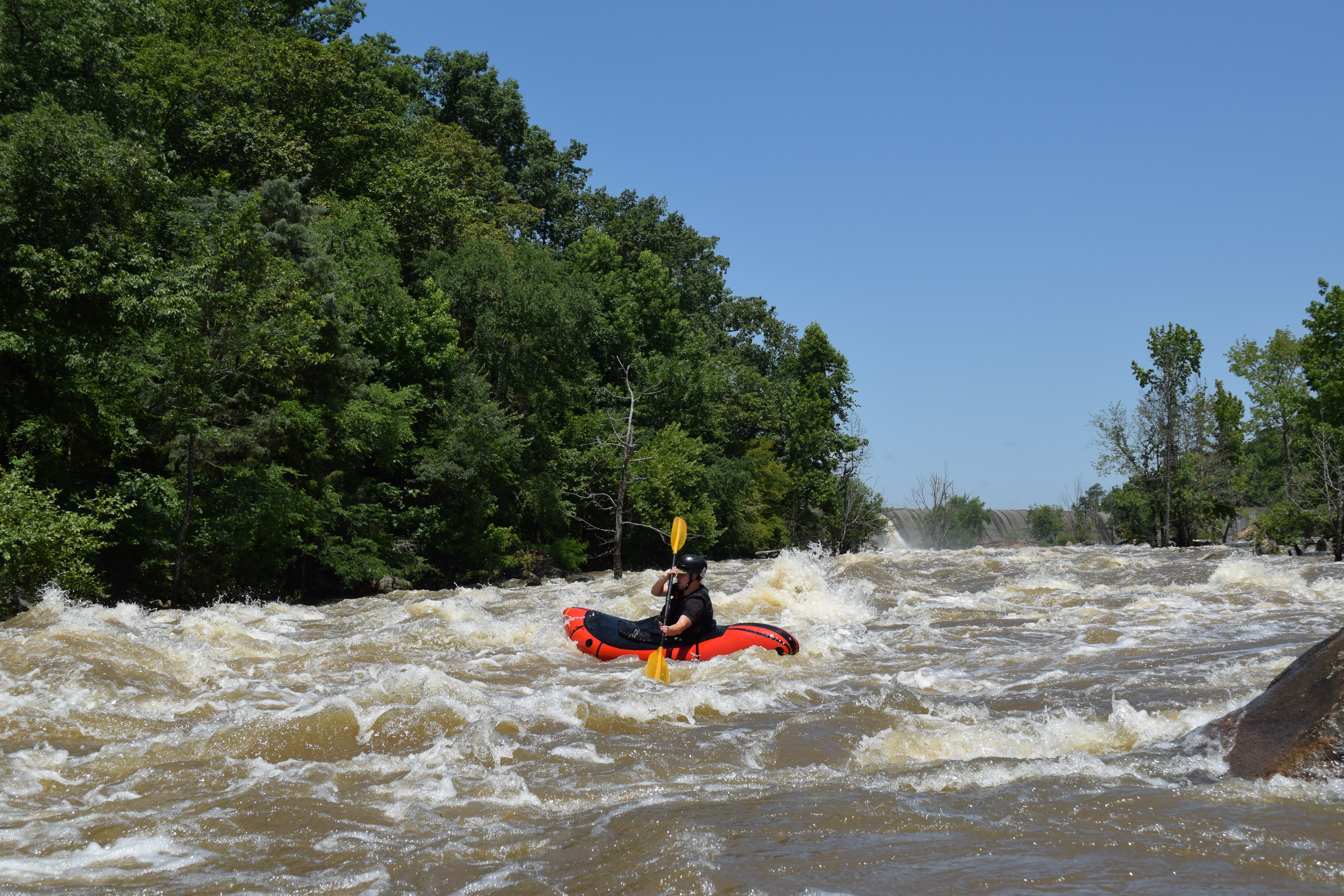
Flow was believed to be around 1800CFS based on the Wylie Hydro Gage data from the day previous (about 20 miles upstream, figured it takes about a day to get here). Myself (Logan Phillips) and Cohen Atkins hiked in from the town of Great Falls. Once at the banks of this channel, we attained up as high as we could on river right, before ferrying across at the base of the upper rapid. Once on river left, its 200 yards of Class IV rock scramble and wading to get to the base of the dam where the water enters the channel. Please do you own research as to how to get to the channel legally, the dam and surrounding land is owned by Duke Power. Currently there is a massive notch cut out of the dam, which is dumping the entire flow of the river into this channel allowing the long channel to stay completely dry during construction. See photos, it's quite an impressive spout of water. No clue how long this will be the setup, but my guess is that until they are done with the work on the long channel (end of 2022), the short channel will be flowing with what I estimate to be about 2000cfs. Any more, and it appears to overflow into the flatwater bypass (channel closest to town). For those of you that aren’t into ridiculous portages and complicated logistics to run a 3 rapids, it might be best to wait until the new put-in is complete and scheduled releases begin.
Without further ado:
'Turtle Back' Rapid (III-?): Starting at the dam, the main flow goes left around a rocky island with a tree. Flow is then split by a logjam. Line is to the right of the logjam. Immediately past the logjam there is Turtleback . There are (at least) 2 options. Go just left of the exposed rock on the right for a straight drop (this might turn into a nasty pour-over at release levels), or head straight down the center, avoiding the Turtle Back shaped rock that is just under the surface about 8' from the river left bank.
'Great Waves' Rapid (III+?): Once through Turtle Back, there is about 50 yards before you enter the meat of the run. You'll see an 8' wide rock that looks like a toilet bowl in the center of the river. This toilet bowl rock marks the start of the rapid. Line is to the right of the toilet bowl. Pick your way down. Lots of surprisingly pushy water, back-to-back small drops and surprise holes. Hug the right bank for the easiest route, or down center-right for a bit more action. Left bank has a submerged tree. Rapid ends in wavetrain that looks like it could liven up at release-level flows. Reminiscent of Radiotower on Lower Noli, just without the getting-stuck-on-every-rock part. Lots of elevation drop over the rapid, but it's a consistnet grade with no major, nameable drops or holes. Looks to be potential for playspots and surfing at release flows.
Next, there is about 150 yards of pool before the second (and final) rapid.
'Barracks Ledge' Rapid (III): The mid-run-pool ends with a small rocky island with a few trees and a river-wide line of boulders. It's a bit of a choose-your-own adventure, but everything to the right of this island is filled with dead wood, so not the adventure I would recommend. We took the left channel, staying 10 yards or so off of the left bank because of the dead wood here also. Around the side of the island, (maybe 75 yards in) you'll see a horizon line. Some lines are cleaner than others, but the best option we saw was to simply run the ledge straight down the middle. It’s about a 3' drop, comparable to a mini version of Murphy's ledge (Noli Gorge). Rest of the way down (200 yards or so) to the lake is just a Class II+ game of dodge-the-barely-submerged rock.
Quick history lesson - around 1800 Washington + Jefferson decided to build an Armory in this area to serve the southern states, at the same time they approved construction of the Harpers Ferry and West Point Armory. Eli Whitney (yep, the Cotton Gin guy) was the one that selected + surveyed the land, and Colonel Senf was the engineer in charge of the construction. Senf died and was buried nearby in an unmarked grave. The armory, barracks, powder magazine, blacksmith shops, and artillery storage sheds were built, and staffed, but nothing was ever produced. The war of 1812 happened and focus/ funding was redirected to Harper’s Ferry + West Point. By 1825 it was abandoned. The 80 acres worth of ruins will be accessible as part of the overall whitewater project and 500+ acre state park, but for now they are on private land.