American, North Fork
Euchre Bar to Mineral Bar(Giant Gap)
April 20, 2023
| Reporter | Nicole Smedegaard |
| Flow | Medium Runnable |
The put in for Giant Gap includes a 1700 ft descent from Euchre Bar Trail Head over a distance of one and a half miles. In layman's terms; it’s steep! This trail I’m sure is a jaunty day hike down to the bridge where sweaty poison oak covered enthusiasts can jump into the ice cold deep green pools of the North Fork. As a raft put in though, it is a bit unconventional. The average river user must imagine wide open cement parkways gently sloping into sparkling waters on a hot sunny day at the “boat ramp.” Nope. The reality is that the Sierras are well known amongst the whitewater community for involving access points that are more likely to destroy your sled than the rapids are.
Wait, I thought we were going boating, not sledding? There are multiple schools of thought on how to get a raft down a trail, all of which we have tried, none of which are great. If the trail were shorter or wider, we could carry the raft inflated. Although rafts are full of air, they are surprisingly heavy! The AIRE Sabertooth my partner and I R2 (one raft, two paddlers) is 75 pounds and that’s if it’s dry, plus our kits. For a one day trip without overnight gear, my paddle partner and I are each looking at carrying half our bodyweight to get on the Giant Gap run. Gravity is helping here, so one idea is to sled the weight down the hill on a toboggan. The record setting snow year manifested on the retail front as the great toboggan shortage of 2023, but after some creativity, our crew found one and we decided to use it for the bigger yellow raft. The hardshell kayaker also chose the sled technique, setting up a standard stern to bow leash system to control the descent.
The sled worked until it didn’t, which was less than a quarter of the way into the hike. The blue plastic cracked, then broke after hitting the sharp rocks in the first portion of the trail. (We should have carried over the road bed and then dragged upon reaching the softer trail.) We quickly reevaluated the situation and decided to go caveman style, which obviously means dragging two sticks under the load. This worked and got our buddies’ yellow raft the rest of the way down the mountain. At the river’s edge we discarded the sticks back into the forest whence they came and smashed up the sad blue sled, bagged it, and jammed the remains into the bottom of the raft.
The best alternative to gravity assisted drag sledding is to pack in the boats on our backs. The advantages here are mostly for the boat’s sake. You can imagine what those sled shredding rocks would do to an inflatable craft! The problem with back packing the raft is its bulk and weight, finding a pack that can accommodate such an awkward load has always been an issue. We have tried external frame style hunting packs, but the bulky external frame is a hazard while in difficult whitewater, getting chundered in a hole or flipping off a rock. Stashing a sled in the raft is also not ideal. NRS makes a pack that is meant to carry a dry bag, so we tried that last year but the straps were too short and the load wobbled and bounced, destroying our knees and my will to live. It also fell apart at the stitching and needed to be strapped back together with cam straps. I don't think NRS makes it anymore. For Giant Gap the best method we have found is a pack made by Six Moon Designs. The Flex pack is meant for packrafting. Technically, we are packing a raft; which surprisingly does not equal packrafting, which is obviously its own sport. This pack solves several of our problems, it is small and soft enough to stuff inside a drybag and strap to the back of the boat for our day on the water. On the trail, it has stabilizer straps that keep the load close to your body and extra long load straps to circumnavigate our girthy boat. The hip belt and shoulder harness are padded out and comfy like a traditional through hiker pack. We didn’t try out the fancy water bottle holders for fear of adding any extra weight to the unsightly load. Six Moon Designs gave me a few Flex packs to try out with the heavy load, so a big should out to their product!
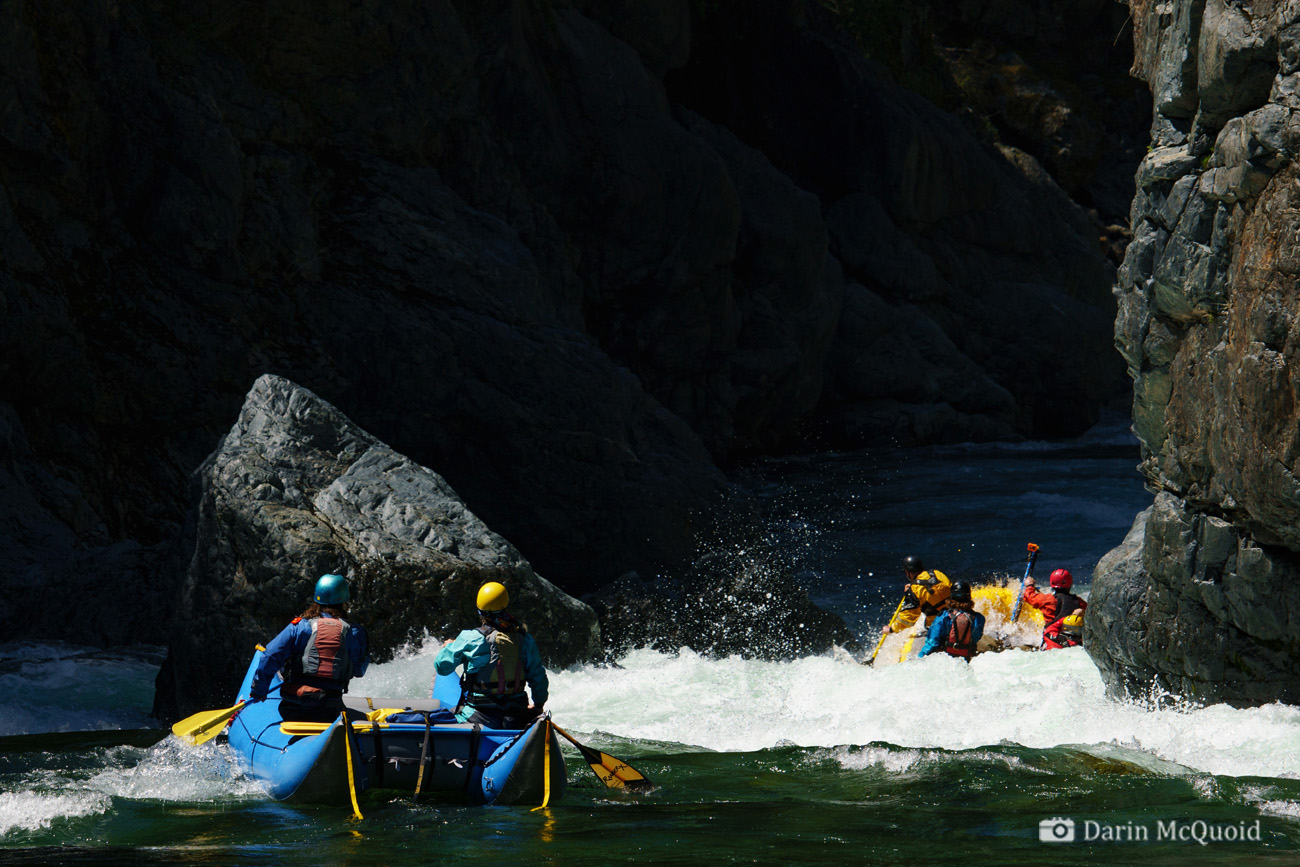
Once we get to the river, all the gear explodes into brightly colored piles of rubber as we begin to inflate the rafts. We shimmy into drysuits, double check hemet buckles, and push off into an adventure. Downstream we nervously await my favorite rapid of the run, Nutcracker. The R4 team in front of us disappears over the horizon line into shadows between two vertical walls. They get pushed into the right wall at the top so we enter more center. We drop in next and I say “we might want to square up to that one!” There is an enormous left hand lateral in the slot at our juicy flow of 1600cfs. We crash through and are lifted high over the crest, skipping over the last hole and through the narrowest point at breakneck speed. We are all smiles, whoops and hollers as the crew makes it through successfully. The best feeling is right there with our friends, knowing we have a whole day of river adventure ahead.
In conclusion: last year we packed in rafts at 1350 after a rain event, this year at 1600 snow melt felt significantly more cushioned out and was an easier flow for a raft. Five Alive had the center seive pile covered up enough that water was not pushing into it as much. Dominator had a lot more water moving right of the huge feature at the bottom. At lower flows it was difficult for a raft to climb the hill of water to make the left to right move. I prefered the higher flow, and can confirm (for rafts) that the hole at the bottom of Locomotive was not bad at all. Some of the most retentive holes were the 2 rapids just before the waterfall lunch spot. You want a crew with a class V skillset due to the remoteness and endurance aspect of the run as well as for the Dominatrix into Dominator section, which all ran together (with small eddies) at the moderately higher flows.