Pimmit Run
1. Old Dominion Drive to above Glebe Road
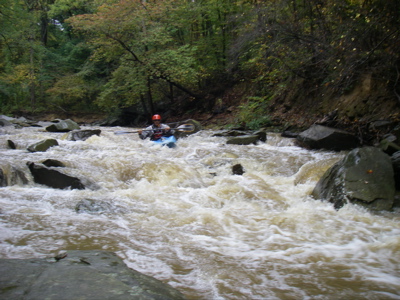
Oct 27, 2007
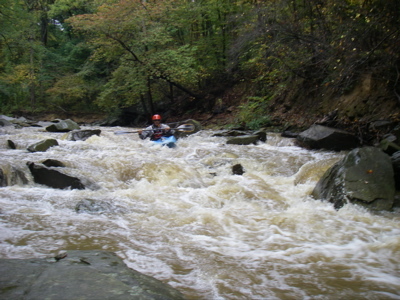
Peter runs one of the lower rapids on Pimmit Run
Pimmit Run runs through several manicured McLean backyards!
Oct 27, 2007
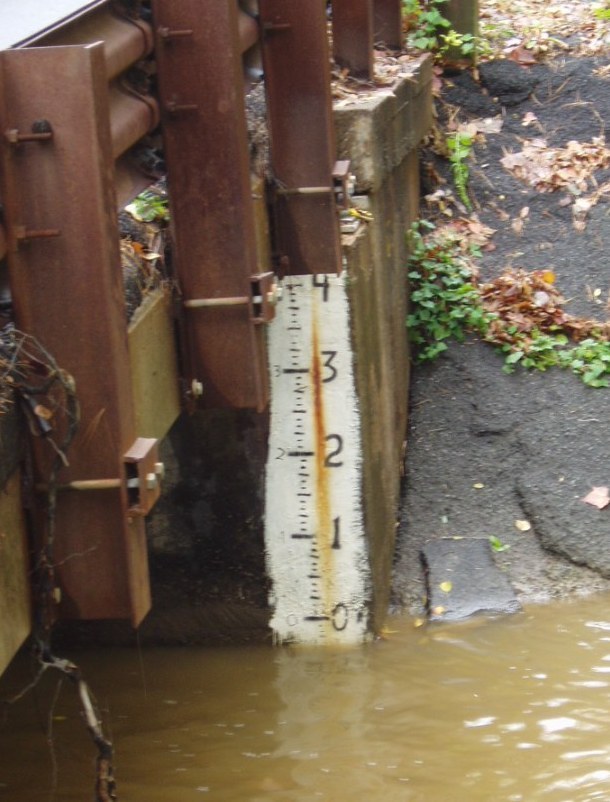
Pimmit Gauge is on downstream side of bridge over Kirby Road - looking toward 123 - Alf Cooley installed it and it seems pretty accurate.
Oct 15, 2005
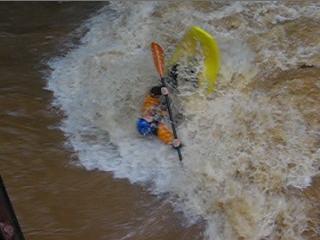
Taber and I found a super play hole that forms under the Old Dominion Bridge during high water.
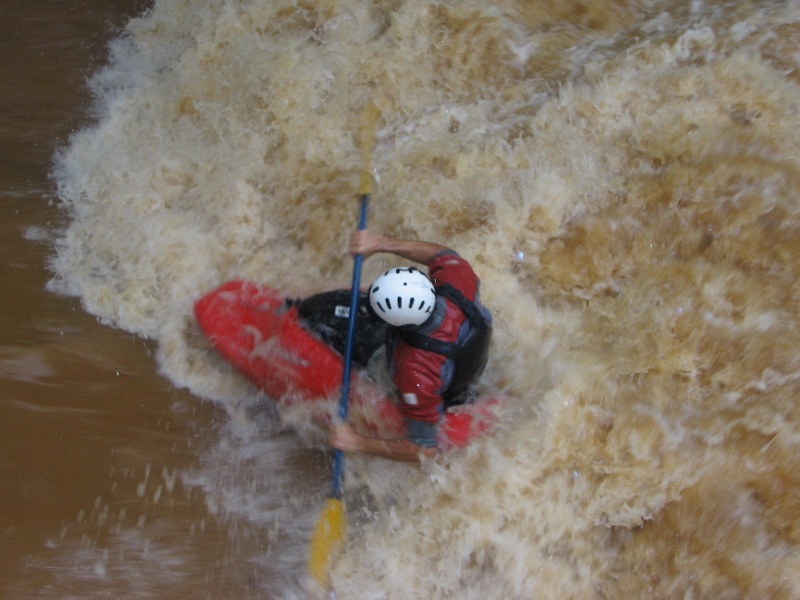
Taber and I found a super play hole that forms under the Old Dominion Bridge during high water.
Oct 13, 2005
Taber and I found a very nice play hole at the putin, under the Old Dominion bridge. We caught this after a heavy rainfall (4 inches that day, plus 4 inches the previous day). The area upstream of the Old Dominion bridge was flooded over the banks. This caused enough of a drop under the bridge to form a good, deep play hole. The hole was 10 feet wide and two feet deep with a nice river left shoulder and excellent eddy service.
For reference, the Four Mile Run gage was at 2000 cfs.
Dec 22, 2003
Pimmit Run empties into the Potomac River just downstream of Chain Bridge. It has a small watershed and subsequently runs infrequently. This is a micro stream that tilts downhill at a nice pace without any significant rapids above the Glebe Road bridge. The riverbed is primarily composed of small sized boulders with several 1-2' ledges. There were a few strainers in the riverbed, but none posed a problem other than one that spanned the entire stream that we were able to squeeze under. We choose to park at the take-out and hike 3/4 of a mile upstream on a river right path (the Potomac Heritage Trail) and put in under the George Washington Memorial Parkway bridge. For a longer trip (approximately 2 miles) you can put in at Kirby Road at the confluence of Pimmit Run and Little Pimmit Run, however, the majority of the gradient is in the final mile. This is a low volume stream with no gauge. If it looks runnable at the take-out it is good to go. It is important to note that as with many local creeks, the water is urban runoff and contains the associated pollutants and odors. However, Pimmit Run appeared to be much cleaner than Difficult Run or Cub Run which are particularly unpleasant.
The first part of the run from the put-in to the Glebe Road bridge is continuous, technical class II-III. The difficulty would be greater with more water, but most of the rocks would be padded out or under water opening things up a bit. There are several fun slots and boof rocks through this stretch. A note of caution, there is a low water bridge (the remains of an old grist mill) with a large strainer under the Glebe Road bridge that is a mandatory portage. The flow under the bridge is diverted through one four-foot wide culvert on river left that has a strainer on the upstream end and a wall two feet out from the outflow that the water rebounds off of on the downstream end. It is easily carried on river right, but make sure to grab an eddy before being swept into the strainer. The final plunge from the bridge to the Potomac River is short, but intense. The current is swift after the bridge and quickly brings you to a large horizon line. This drop should be scouted on both river right and left while making your portage around the low water bridge. The creek drops a total of about fifteen feet over a series of irregular 2-10' ledges in the span of about twenty-five linear feet. The line I choose was to boof a three-foot high broken ledge in the center of the creek. The landing zone is only about twelve feet long and six feet wide before you have to immediately boof another three-foot high ledge. This ledge needs to be boofed on the far left of the five-foot wide slot. The move is quite tricky in that all but the far left side of the landing zone puts you into a hole that is backed up by a boulder creating a dangerous recirculation area. Boofing on the far left sets you up to land in a small hole and you then need to immediately boof a sixty degree, eight-foot high slanting ledge with a rock protruding up in the middle of the ledge. This slot is only three feet wide, barely big enough for the boat to fit through. The slide terminates in a two-foot ledge and then you're in the backwater of the Potomac. To complicate matters, the rocks in this drop are very angular and many are pointed upstream. A flip would certainly bring about an injury. Call this drop a class IV.
The day we ran Pimmit Run the Potomac was running at 9.5' on the Little Falls gauge. I went back to Pimmit Run on a day when the Potomac was at a more reasonable level and was surprised to see that I had only run a little more than half of the final rapid. The remaining half of the drop had been inundated under water on the day we were there. There was an additional ten vertical feet of rapid that is complicated by piton rocks and boulder sieves. From the base of this drop the creek continues at it's steady pace for the final hundred yards to the confluence with the Potomac.
This is a fun run. We ran it at what I would call the absolute minimum level and it was scrappy the whole way down. Everyone broached at least once on annoying little subsurface rocks. The creek doesn't hold water well and the volume dropped by approximately a third from the time it was scouted until we put on (2 hours). Nonetheless, it was well worth the effort.
John_E_Sunshine