San Lorenzo
Felton (Henry Crowell State Park Bridge) to Ocean at Santa Cruz
January 5, 2026
| Reporter | Adam Stavash |
| Gauge Reading | 2600 cfs at SAN LORENZO R A SANTA CRUZ CA |
| Flow | High Runnable |
On the drive down to SC it was pelting rain, prompting numerous checks of the level: 2000 cfs and rising… great? After arriving and some deliberation, we decided we’d give it a go at the high flows. By the time we set shuttle and got on the river it was around noon, and the flow was roughly 2500 cfs and still rising.
We put in at the Felton Covered Bridge and took out at Santa Cruz Memorial Cemetery, after some uncertainty regarding the parking situation at Paradise Park. If we were to run it again, we would put in at the bridge headed toward Henry Cowell State Park and take out at Paradise Park (if possible). This would have cut out some flatwater and blind corners into brush.
From previous trips, we expected the character of the rapids to be mostly Class III with one Class IV. The wildcard was wood. We had heard a few days prior that there were five river-wide log portages, which made us nervous given the high flows.
After putting in, we encountered our fair share of blind corners with questionable brush and wood situations. It was fairly common for the river to split into a couple of channels around bushes. We used a combination of following where most of the water was going and some guesswork to make it through. The worst of the early wood forced us to jam our boats through some brush on river left. Nothing terrible, but it definitely made me nervous for the rumored log jams downstream.
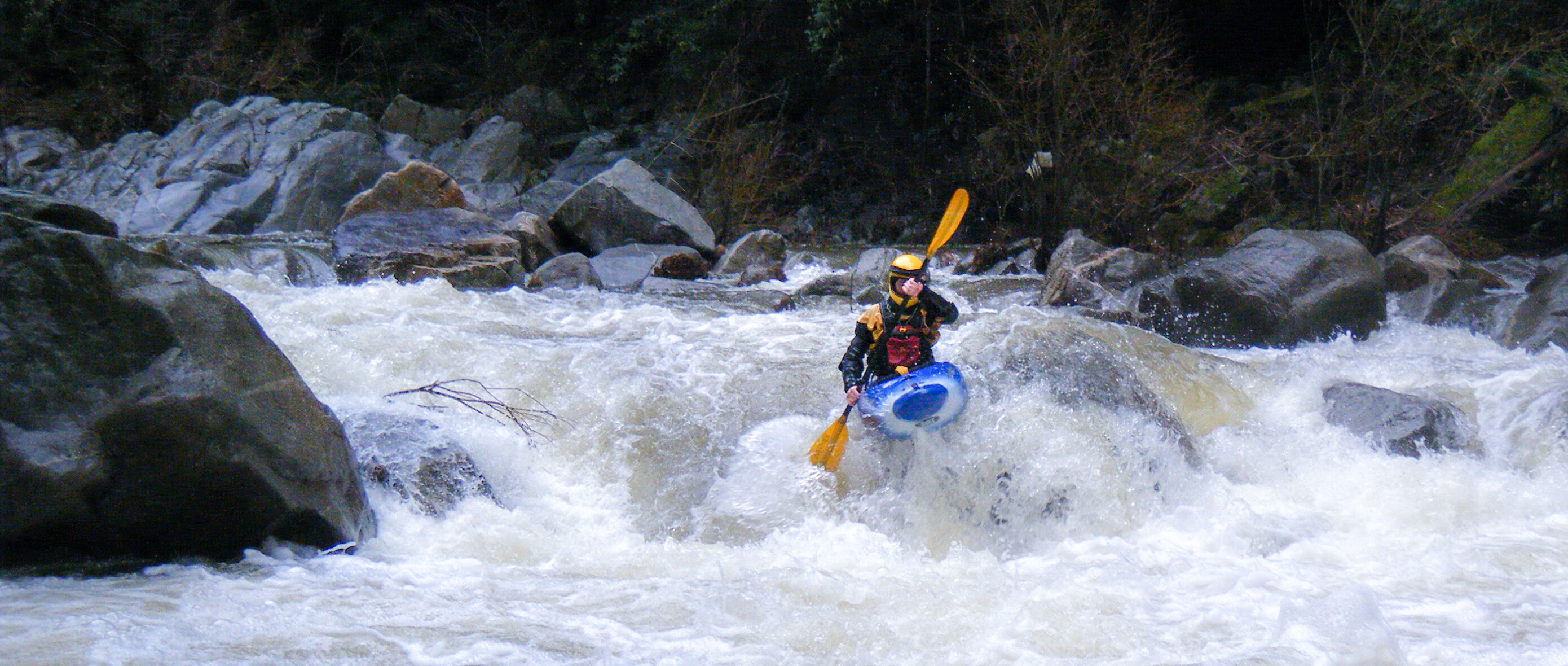
When the rapids start, they get going quickly. At our flow, most of the gorged section ran fairly continuous, requiring careful eddy choices to boat scout most of the drops. The character of the gorge was large, pushy Class III with some big features that were relatively easy to avoid. After the river does an S-turn through some pushy rapids, it makes a left turn where there is a very large redwood tree fallen across the river. We were able to easily duck under it on river right. This tree can be used as a marker for arriving at the rapid known as The Waterfall (not actually a waterfall—just the largest rapid).
After passing under the tree, there is a long straightaway where we were unable to boat scout due to the steepness of the river. We pulled into an eddy on river left to scout the drop. (You might also be able to scout on the right, but you could be committing yourself to ferrying above a bus-sized hole, so I’d recommend the left.)
At our flows, Waterfall Rapid was a meaty Class IV+ with some stout holes. The top hole on the right was particularly impressive—and scary. We scouted a sneak line on river left that consisted primarily of Class III moves but was relatively narrow, with big mama holes not far away. Two in our group ran the sneak, and one portaged and set safety on river left. A swim here could be consequential because Waterfall leads directly into the next large rapid.
The rapid below Waterfall looked like a straightforward wave train, but upon closer inspection (while running it), we found it to be more technical, with several large features to avoid. We boat scouted this rapid.
After Waterfall and Waterfall’s “little brother,” the river flattens out and most of the rapids become pushy Class II+ wave trains. There are also more sections that flow through brushy channels similar to the beginning of the run, but with more gradient. Some of these channels and blind corners resulted in nervous eddy catching and awkward boat scouting. Up to this point, all of the brushy sections had runnable channels, but a couple of times we bounced over river-wide logs—which could pose a serious hazard at lower flows.
Eventually we came across a large log jam (we knew there would be at least one). After hopping out on river right and walking downstream a couple hundred feet, we found a narrow channel that went through, with a few submerged logs that were mostly out of play at our water level. This would almost certainly be a mandatory portage at lower flows. You can recognize the channel by the downed redwood tree to the right of it (its probably the largest downed tree ive seen in my life).
After the log jam, the river is mostly flat, which made boat scouting for wood easier. We meandered downstream, passed the Paradise Park bridge that we wished we could take out at, and eventually took out at the cemetery.
After finishing the run, we were surprised to realize there weren’t any mandatory wood portages at our water level. There were many sections that were almost mandatory portages, but ultimately everything went through. This prompted us to jokingly refer to ~2600 cfs as the “perfect flow.” Of course, since wood in rivers like this is constantly changing, on a different day or at a lower water level there could easily be 10+ wood portages—so tread cautiously.
Overall, we enjoyed this section and would come back. The sewage smell was not nearly as bad as we expected (perhaps diluted by the high flow), and there were a few quality rapids. If there were less flatwater + tree dodging—and if the gorge were twice as long—it would be a truly great run. Alas, it’s still worth a look, and made for a fun day on the river.