| Difficulty | II(III) |
| Length | 6 mi |
| Avg Gradient | 15 fpm |
| Gauge | Lehigh R Bl Francis E Walter Res Nr White Haven Pa |
| Flow Rate as of 38 minutes | 290 cfsbelow recommended |
| Reach Info Last Updated | September 2, 2024 |
Projects
Lehigh River Flows (PA)
The Lehigh River is a pretty dam-controlled river in eastern Pennsylvania. It offers paddlers several sections of good class III rapids in a forested river corridor. It also is the first (or only) taste of whitewater that many people in the Philadelphia area get to experience. The river is [...]Read More
River Description
Section of the Lehigh from the Francis Walters Dam to White Haven. Easier than the Upper (White Haven to Rockport) or the Lower (Rockport to Jim Thorpe). A popular fishing stretch, so you have to share the river. The land on either side once you leave the immediate area of the dam is state park land, and boat launching or take-out is not allowed except at state park designated locations.
Put in Directions (to base of dam):
From Route 80 take the White Haven exit. Go North and drive all the way to the Stop sign at Rt. 940. Make a right onto Rt. 940 East and follow it into Whitehaven. Continuing on Rt. 940 East drive a few hundred feet down to Towanda Road and make a left. (If you crossed the RR tracks you just missed it) Follow Towanda Road all the way to the Francis Walter Dam. Make a right at the huge Francis Walter sign and drive down about 1/8 mile taking the first right, a small dirt road, (there are two portable toilets placed there) and follow that dirt road for about a mile until it ends. This is a good stretch for people moving up from Section III (Jim Thorpe to Bowmanstown) to Sections I and II (White Haven to Jim Thorpe). Lightly used (due to better water just downstream) it is usually left to fishermen enjoying some peace and quiet compared to the downstream rafting circus.
Generally, the Top Lehigh contains milder drops than the Upper, making it more suitable for true whitewater beginners. (thx to sk for the description).
River Features
Put In - Francis Walters Dam
Access PointDistance: 0 mi
Put in Directions (to base of dam):
From Route 80 take the White Haven exit. Go North and drive all the way to the Stop sign at Rt. 940. Make a right onto Rt. 940 East and follow it into Whitehaven. Continuing on Rt. 940 East drive a few hundred feet down to Towanda Road and make a left. (If you crossed the RR tracks you just missed it) Follow Towanda Road all the way to the Francis Walter Dam. Make a right at the huge Francis Walter sign and drive down about 1/8 mile taking the first right, a small dirt road, (there are two portable toilets placed there) and follow that dirt road for about a mile until it ends.
Turnpike Hole - Pam's Rock
HazardPlayspotClass: IIDistance: 1.5 mi (approx.)

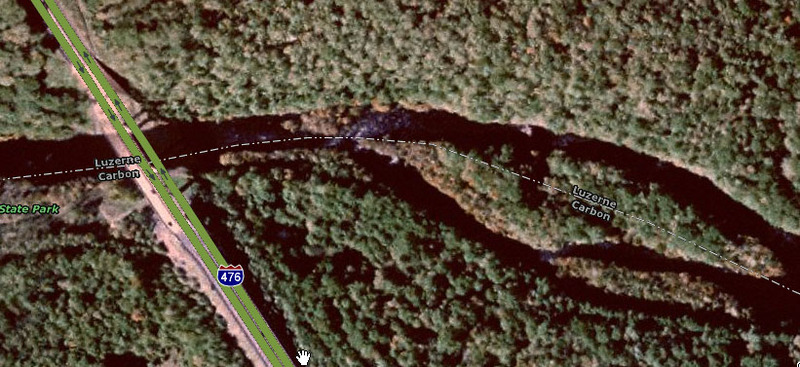
The trickiest spot is just above the Turnpike bridge. An island splits the river here. At the very bottom of the island in the left-hand channel lies Pam's Rock, a boat-length off the right shore of the island. Much of the water down this channel hits the rock and lasts off to the left, almost perpendicular to the river course. Run well to the left of Pam's Rock to avoid this cross current...it's a flipper for beginners.
Small Island Rapid - Devil's Elbow
HazardPlayspotClass: IIDistance: 3 mi (approx.)
From the Philadelphia Canoe Club's JR:
Top Lehigh - Small Island Rapid and Novice Students
Over the years, a number of training groups have had problems at this rapid so I thought I'd blather a bit and open a discussion on it.
Location:
About half-way down the top section, there is a small island with several small trees in the left-center of river. The upstream approach has several large ledge-eddies on river-left separated by 'sliding-board' holes. On river-left just above the island, there is a ledge that forms a swift narrow tongue of water maybe 6 feet wide with a flat triangular wash-over rock obstructing part of the tongue. There are two left-shore eddies just below the ledge and there is a small eddy (or slow water) on the left side of the island. As the wave-train formed by the fast current passes the island (about 20 yards below), part of it plows into a boulder garden on river left before most of the current bends right out to the center of the river. Once in the center, the river is wide, fast and shallow and a boater must paddle around a lumpy left bend to catch a large eddy at the bottom, river-left.
Why this rapid is often a problem for novices:
Many instructors encourage students to boof the left side of the ledge and catch the top eddy before peeling-out or ferrying to the island. On either of these two moves, a student flip in the fast current can result in a long swim past the island and out to the shallow fast current in the center. Once a swimmer and equipment passes the island, rescue is long and difficult with rock broaches for boaters and bruises likely for swimmers until they round the bend and are pulled into the large river-left eddy at the bottom. This is what I refer to as the 'Big Flush.'
Options:
Having ushered about a dozen novice groups through this section and chased numerous boats, paddles and bodies all the way around the bend, I've formed a definite opinion on how to approach it. While doing an out-of-boat scout here, I explain the options available INCLUDING walking it. When we encourage students to take a challenging route without indicating options and risks for their individual skill-levels, then we're subjecting everyone to unnecessary danger.
Aside from portage (which should ALWAYS be an offered option), there are two and sometimes three in-boat options that can be presented when scouting this rapid - depending on the river level and how much support is available.
Option 1 - IF students have been hitting their eddy's high and are able to perform ferries in swift current without loosing ferry angle (or flipping)... then they are a good candidate for boofing the left edge of the ledge, catching the river-left eddy and either ferrying to the island or heading out to the center of the river after passing the island. It is often the top ledge boof or the ferry to the island where long difficult swims start if a students skills are not developed. I've heard of some groups that position an out-of-boat person on the island or wash-over rock with a throw-bag. This is a good idea if you have enough support and your students have been throw-bag trained. Of course, there's no guarantee that a rope will be caught and if I can't spare a helper, then I prefer to have everyone in their boats ready to chase boats and bodies. Once a student and/or equipment passes the island and heads downstream, an instructor or assistant must be expended to chase them. So, spot-on eddy-catching and ferrying skills should be prerequisites for this option.
For students that have NOT been hitting eddy's high and performing swift current ferries:
Option 2 - There is a small tongue of water just upstream from the point of the island that a student can get to with a wide peel-out from the starting eddy. After going through the tongue, a quick right-side sweep is needed to avoid a rock broach. Once they've made the turn to avoid the rocks, the eddy next to the island is easy to paddle into. I usually position myself or one assistant in the island eddy to get there quickly. I like this move for less-developed students because, even with the risk of broaching after the tongue, the current is much slower here and if a student flips and swims, rescue to the island is easy. If an additional assistant helps in a rescue here, they are still positioned to help the next student. This option helps your group stay tight to the island and avoids the 'big flush' for less skilled students.
Option 3 - If the level is 750cfs+, the river-right side is lumpy but passable. The downside to this option is that you need to commit at least one assistant to accompany the student - one that you won't get back to the island area. The start off requires a wide ferry and peel-out to the river-right side and either avoiding or punching a couple of small holes. I only recommend this for a less-skilled student if I have plenty of support and by placing them last in order. Otherwise, it's portage or Option 2.
There are no guarantees and there are probably other options that I haven't considered for this spot. The bottom line is that if we point out what options that a student has and make recommendations based on their skill levels, support and water conditions, then we're doing our jobs as instructors and allowing the student to 'assume the risk' with an informed choice followed by our recommendations. As instructors, we can always say 'No' to a challenging choice if we don't think the students skills are up to it or if support is not immediately available. Concern for group safety should always trump an instructors desire to challenge.
Take-Out - Whitehaven
Access PointDistance: 5.97 mi
Having just built new access circles and toilets, accessed by the road starting at the far end of the White Haven shopping center parking lot, the Pennsylvania DCNR has had to change the White Haven access again. The Pennsylvania DOT is replacing the I-80 bridges across the Lehigh river, so that the White Haven DCNR access has been moved to the Downstream side of I-80. From the I-80 White Haven interchange, turn right on PA 940 going away from the Town of White Haven and immediately look for the DCNR White Haven Lehigh Gorge sign on the left. Turn left and follow this road down to the river for the Put-in. Cars can be parked in a parking lot a little way up the hill. This access is also used for bikers going down to Rockport, Glen Onoko, Jim Thorpe and beyond. Part of the D&L rails to trails system, it is managed by the PA DCNR park rangers.
Trip Reports
Log in to add a reportGG
Gary Gentile
Jun 2, 2016
A detailed description of the entire Lehigh River can be found in the 'Lehigh River Paddling Guide,' which can be purchased online at http://www.ggentile.com/nonfiction\_books.html. Scroll down to the appropriate title.
CM
Carl Marsh
May 29, 2012
I was wondering at what point (CFS) does the difficulty jump the
next level . I am taking some new people out and I wanted some
good starter stuff.
Ok went down to the river and spoke to some guides and they
said that you could run the dam to White Haven at 2800 but he
would only in a sealed boat. He did note that people run it at
800-1000 with open boats like i have (10ft kayak no skirt yet)
Ok an update My friends and I went on Sunday a dam release day Water CFS was 800 CFS and 4.2 ft. 2 of us on 10ft kayaks and one on 12 ft. The only one who flipped his kayak was in a 10ft and he seemed to be aiming for rocks. We were told by some others at the end that we were out of our minds but I don't really think It was that bad. Some hairy parts but the rapids were scattered so you could recover in the slow parts. I had to stop 3 times to drain my kayak from water splashing in. I'm no expert but I do have the skill to hold a line i see and avoid rocks. I will do the run again but with a skirt.