Plum Creek
1319 to Hwy 44 (5.37 miles)
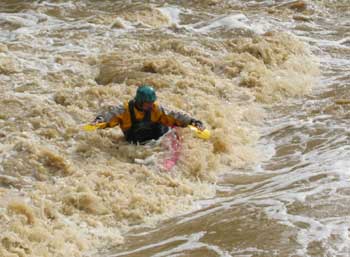
December 8, 2007
| Reporter | chris stoops |
Best rafting day of my life: Ran Plum at 1 foot as it drained down to 6 inches. Hazard to include: Below KY 155 about a third of a mile is a low water bridge. The 3 foot ledge wasn't runnable on right at such a low level, but we were able to climb up that side to re-run this rapid, which I did 4 times. Left middle was the most fun, and far left is broken in to two ledges with no hydraulic whatsoever. The only bad experience I had was on this 3 foot drop: The main current flushes out in the very middle and creates a very nasty keeper hydraulic that tossed my raft like a raging bull, and I only escaped thanx to my throw-rope and my brother pulling me out. We also encountered a ledge that was very sticky; we fell in the middle and we were only able to escape this hole by eventually making are way to the very left of the creek. Another ledge had a very sticky hole on the middle right. There were tons of eddies at 1 foot, and if your inexperienced this is a great level for you. If you ever get scared just stay to the left EXCEPT for the class III rapid under the forth bridge, run it far right.
-Note- To view the pages below: Copy the URL(http://www.whatever.com) and paste it in your web browser's Address bar, and press Enter. I have invented two different ways of figuring out whether it's runnable. The first is a gauge of a creek named Cedar Creek, a high-water stream (that is, streams that can only be run after exceptionally heavy rains) just like Plum Creek is, and with a similar gradient as Plum (17 FPM average, 35 FPM max). The only difference is that Cedar Creek isn't as wide, and it has a gauge. But since both of these creeks are highwater creeks, with the same gradient, and the gauge is located 10 miles west of Plum Creek; it's a great way to see if Plum is running. The next method is to look at the precipitation gauge at the Ohio river. If 1.4 inches of rain falls in 4.5 hours, plum will be running as long as the same storm that hit downtown by the Ohio has hit Plum Creek, then this method is very accurate I think. Or you can just watch the weather channel to find out how much water has fallen. I think it flashes up super quick at the very bottom during your local on the 8's. This is a picture fully explaining everything using USGS charts and some explanations, and it is to be used as an example to see what it is going to take rain wise to get to run Plum:
http://img127.imageshack.us/img127/949/plum0pl.jpg
Below is the URL to the Cedar Creek gauge and you can check it all the time after every storm and you will soon learn that it is definitely a highwater creek just like Plum. If the creek were 5 or 10 feet wider it would be Plums exact clone as far as the way it fills up and drains water. If this gauge said that Cedar Creek maxed out at 3 feet and it's currently at 1.6 feet, then plum should be at 1 foot(as long as the storm hit both creeks, there only 10 miles apart). It would be even better if you got in Plum when Cedar was at 3 feet of course. I wouldn't recommend running Plum just cause Cedar maxed out at 1.5 feet, because Plum and Cedar would loose that amount of water very quickly. I have found my cedar gauge to only be accurate up to 1 foot, if cedar says one foot then plum should be at half a foot. This has been tested on four different occasions or more, and all of the tests were in my theories favor. Here is the URL address to the Cedar Creek Gauge:
http://waterdata.usgs.gov/ky/nwis/uv?cb\_00065=on&cb\_0006
0=on&format=gif&period=2&site_no=03298250
To find out how much it has rained at Downtown Louisville, use this URL address to the Precipitation in inches gauge, it is at the bottom of the page: http://waterdata.usgs.gov/nwis/uv?cb\_00065=on&cb\_00
045=on&format=gif&period=2&site_no=03294500
UPDATE: Here is a link to tons precipitation gauges all around Louisville:
http://www.msdlouky.org/aboutmsd/rainfall.cfm
If the storm is going from west to east, then TR08 (Fern Creek) plays an important role in finding our if Plum is runnable, especially if the storm is heading north east.
TR07 (Floyds Fork) also plays an important role, if both of these gauges say that there has been a total of 1 inch of rain, Plum might be at a low runnable level, but if they say 1.4 inches, and if it’s wet season, and if all of that rain fell in 4 hours, and the storm is heading in a western direction, then you can bet it’s running. TR15 might also play an important role, I forgot I’ll have to go rummage through my notes and give a more in depth explanation later, and yes I’m serious lol.
