
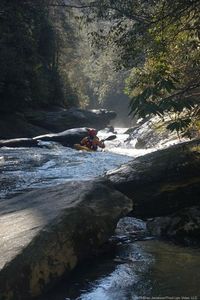
The US Forest Service released its “Scoping Document” regarding recreational management on the
This official public comment period is one of only two remaining opportunities to let the USFS know what you think about the 30+ year old boating ban and the 30+ years of neglect on the
The Scoping Document can be downloaded here: www.fs.fed.us/r8/fms/documents/Chattoogascopingpackagefinal08142007.pdf
The Scoping document outlines six alternatives that the USFS intends to analyze this fall in an Environmental Analysis, unless comments convince the agency that there are other alternatives that should be in the scope of their analysis.
Of the six alternatives only one does not unfairly single out paddlers for harsh limits while allowing other users to visit the
– Alternatives #1, #2, and #3 propose a total ban on boating. Other uses are unlimited in #1 and #3, while #2 proposes to limit other uses if a standard of 3 encounters per day is exceeded.
– Alternative #4 proposes a total ban on two sections of the river and harsh group number, seasonal, and water level restrictions on the rest of the river. Other uses are unlimited.
– Alternative #5 proposes a total ban on one section of the river and water level and group number restrictions on the remainder of the river. Other uses are unlimited.
– Alternative #6 allows boating on the entire river. Other uses are unlimited.
American Whitewater has participated fully in the process leading to this document and we have been frustrated at every turn. There is simply no data that indicates a rationale for treating paddling differently than the other wilderness compliant uses of the river as this scoping document clearly does. Why is boating limited or eliminated in 5 alternatives while other uses are only limited in one? Why are alternatives not organized by various capacities and their effects as would clearly make sense? Why has the local USFS ignored the Chief’s direction in the AW appeal decision?
Even after spending over 1 million dollars, the USFS has not presented capacities for any or all uses of the
The silver lining in an otherwise confounded scoping document is that all the action alternatives finally propose real resource protection measures like moving campsites out of riparian areas and fixing eroding user created trails, and several propose registration by all users. These are standard restoration and protection initiatives that are not in the 2004 Land and Resource Management Plan but will almost certainly be in the amended version of the plan. American Whitewater views this as a tangible and positive outcome of our appeal of the plan in 2004.
American Whitewater sees no basis whatsoever for alternatives one through five and feels that they are both blatantly unfair and inadequately protective of the
Again the deadline for comments from the public is September 13, 2007. You should submit your comments by the September 13th deadline to comments-southern-francismarionsumter@fs.fed.us or mail them to John Cleeves, U.S. Forest Service,
Please stay tuned into AW’s website during the next several weeks. We will be offering our recommendations within several days.