
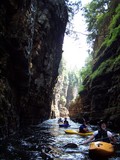
Today, American Whitewater filed a formal challenge of a May 1, 2009 decision by the Federal Energy Regulatory Commission (FERC) to prohibit public boating access to New York’s Ausable River for 7 months of the year, while allowing access the other 5 months. The dam owner, New York State Electric and Gas has totally blocked access to the river for the past several decades. FERC’s decision follows a decade of analysis and public participation that culminated in a 2008 Environmental Assessment in which FERC staff found no reason to prohibit public river access, and ample cause to justify their (2008) recommendation to restore year round access to the river.
FERC’s recent decision to allow only 5 months of access annually, rather than year round access as they had originally recommended, was based on inappropriate new analysis of irrelevant climate data. This faulty analysis led FERC to the false conclusions that the river was too high to paddle in spring and that it was too cold to paddle in the late fall, winter, and early spring. Based on these false conclusions, FERC recommended a seasonal closure to “balance” paddling demand with unfounded safety concerns and inflated cost estimates for providing access.
FERC’s decision to allow the dam owner to block public access for 7 months annually contradicts relevant case law and clear FERC policies requiring the “ultimate development” of recreational resources at dams. The decision also is in violation of the Federal Power Act which guides FERC’s actions. American Whitewater is challenging this decision because the Ausable is a valuable year round paddling resource, and also to prevent a bad precedent from being set that could impact public access to other rivers throughout the United States.
FERC’s decision and our Request for Rehearing can be downloaded in the Document Box to the righthand side of this article. The Request was prepared in collaboration with the superb legal team at the Natural Heritage Institute. FERC will now consider our Request. In the decision (which we are challenging), FERC granted the dam owner 4 months to develop a new access plan and additional time to actually build fencing prior to allowing access. Our rehearing request may (or may not) slightly delay gaining public access to the river, but this slight delay is well worth it when compared to 40 years of the 7-month annual closures currently proposed.
Securing 5 months of annual public river access to this incomparable river – after decades of no access whatsoever – is certainly a major success for American Whitewater and the paddling community. While we are challenging the unfounded 7-month annual closure, we would like to thank the many paddlers and organizations that wrote FERC in favor of public access to the Ausable River over the past several years.