
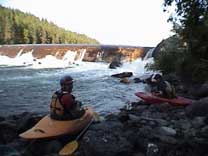
American Whitewater, working as a member of the Hydropower Reform Coalition, filed comments opposing proposed rulemakings by the Department of Commerce and the Department of Interior. Commerce and Interior are proposing in separate rulemakings to severely limit public participation in hydropower licensing proceedings. Commerce and Interior are proposing to give dam operators special privileges to appeal agency license conditions while at the same time excluding the public from this appeals process. Excluding the public from the appeals process on federally navigable waterways is fundamentally unfair. The Hydropower Reform Coalition consists of twelve member organizations on the steering committee and more than one-hundred general member organizations.
Joint comment letter submitted to the Department of Commerce and Interior.
***********************************************************************
November 8th, 2004
Thomas Bigford
Chief, Habitat Protection Division
Office of Habitat Conservation
National Marine Fisheries Service
1315 East-West Highway
Silver Spring, MD 20910
RE: RIN 0648–AS55, Procedures for Review of Mandatory Fishway Prescriptions
Dear Mr. Bigford,
The undersigned organizations are writing to comment on the proposed Procedures for Review of Mandatory Fishway Prescriptions Developed by the Department of Commerce in the Context of Federal Energy Regulatory Commission’s Hydropower Licensing.[1]
Our organizations generally support codifying the Mandatory Conditioning Review Process with the noted adjustments to accommodate the ILP and changes to all licensing processes under that rule. We are, however, concerned about the variance in the ways that the Departments of Commerce, Interior, and Agriculture review mandatory conditions and administrate (or fail to administrate) their appeals for those conditions.
Mindful of this variance, Commerce asks the public to comment on the addition of an appeals process,[2] and whether it should follow the framework adopted by the Department of the Interior.[3] It also asks whether hydropower licensing legislation considered in Congress might also contain useful elements of an administrative appeals process.[4] Our answer to both questions is clearly no.
While our organizations are generally supportive of an appeals process that bridges between a final condition and a lawsuit, the appeals process proposed by Interior is unacceptable. Should Commerce develop an appeals process, it should structure the appeals under the following guidelines:
I. The appeals process must be available to all stakeholders.
Interior’s proposed process would allow license applicants the sole right to initiate an appeal. Stakeholders with legal standing in the administrative proceeding would be denied access. Public participation is intrinsic to the Federal Power Act, which ensures equal access to the administrative proceeding. Privileging the dam owner with exclusive authority to challenge conditions is discriminatory and disadvantages all other stakeholders, undermining the balance of the licensing process.
II. The appeals process must defer to the original decision and include on-the-ground scientific staff on any review team; otherwise, the process will politicize what should be science-based decisions.
The Department of Interior’s proposed process would not lead to informed decisions regarding appropriate mandatory conditions. It would invoke a de novo review. Unlike Courts of Appeal, which would defer to an agency when reviewing its decision, the proposed process would eliminate such deference. Commerce would establish a Washington D.C. policy-level team to review the decision. Under its terms, none of the members of the review team can have previously participated in the development or approval of the condition or prescription – in other words, none of them would be familiar with the relevant resources or the rationale for the condition. And, this team would be expected to review a cabinet-sized record and render a decision within 60 days.
Tight timelines, unfamiliarity with the extensive record and our resources 3,000 miles away, and lack of direct expertise are insurmountable obstacles to quality decisions and to a realistic process.
III. The appeals process should not consider criteria outside its mandate to become a basis for appeals and a factor in the decision.
The appeals process proposed by Interior would allow consideration of such factors as cost, air quality, and energy supply. Our organizations are adamantly opposed to reaching outside the resource mandate of the agency to incorporate inappropriate criteria such as those listed and anticipated in the federal legislation. The Federal Power Act charges FERC with the responsibility of equal consideration to beneficial uses as it decides whether and under what terms to issue a license. It is neither within the mandate nor the role of Commerce to consider these other variables in the development of a prescription.
In summary, we support codifying the Mandatory Conditions Review Process (MCRP) and establishing a non-discriminatory appeals process that is equally available to all stakeholders, but wholeheartedly oppose an unfair and unilateral appeals process, such as Interior’s proposal, that threatens the quality of protections for our rivers and resources.
Sincerely,
John T. Gangemi
American Whitewater
[1] 69 Fed. Reg. 54,615 (Sept. 9, 2004)
[2] III. NMFS solicits public comments and specifically invites commenters to consider differences relative to the Department of Interior.
[3] 69 Fed. Reg. 54,602 (Sept. 9, 2004)
[4] III. NMFS invites comment about whether elements of the legislative proposal should be incorporated into this rulemaking.