
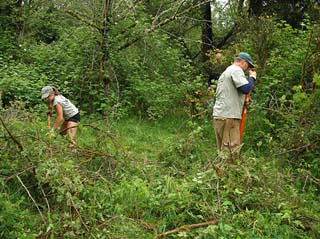
American Whitewater is part of a coalition of groups currently working to develop a stewardship plan for invasive weeds in the Middle Fork Snoqualmie River Valley. Volunteers are central to this community effort and paddlers in particular are encourage to join the any of the following events planned for this spring: Signup for these events ==>
Invasive Removal Volunteer Event: Tanner Landing
Sunday, May 14th in North Bend, 9 am – noon.
King County recently purchased a parcel along the Middle Fork Snoqualmie as a site for future river access and for development as a community park. Local affiliate Washington Recreational River Runners, has committed to assist with developing a vision for the site and initiating important stewardship efforts that include gaining control of an infestation of Scot’s broom. All are welcome to particpate with an opportunity to go boating after the event. Meet where the Snoqualmie Valley Trail crosses Mt. Si Road. Advanced sign-up is recommended but not required (this will ensure that we have an adequate supply of tools).
Mid Fork Snoqualmie Invasive Plant Identification Workshop
Saturday, May 20th in North Bend
9:00 AM – 11:00 AM ~ training
11:00 AM – 1:00 PM ~ field session
This educational opportunity is open to the public. Experts from the King County Noxious Weed Control Program will lead a classroom session using live specimens and slides, followed by field identification session in the Middle Fork Valley. Particiapnts will meet at the US Forest Service Ranger Station in North Bend and then head out for several hours in the field. The class is free and open to the public, but please sign up for agenda details and directions.
Mid Fork Snoqualmie Invasive Plant Survey
Monday and Tuesday, June 5,6, 2006
Community organizations and staff from King County and US Forest Service will be conducting a survey of invasive vegetation along the river corridor on the Upper Milddle Fork Snoqualmie. A big thanks to Seattle Raft and Kayak who will be providing raft support for those conducting the survey. We are also iniviting paddlers to participate in this effort. The objective will be to map infestations of exotic invasives for future removal. We are especially interested in having paddlers join who may be interested in helping organize future stewardship efforts along this stretch of river. Advance sign up is required.
Background
The Middle Fork Snoqualmie River Valley is one of King County’s truly wild places, with remaining pockets of old-growth forest, fantastic whitewater, and strong native trout runs. Land managers and local groups have worked for decades to protect the 110,000-acre valley and promote low-impact recreation. An effort to control invasive weeds in the valley is the next step in this long effort to protect the Middle Fork. With much “infrastructure” work accomplished, land managers and non-profit groups are now focused on long-term stewardship, including the Invasive Weed Control Project. This project will remove small infestations of invasive weeds from critical valley habitat before they become a bigger problem.
Invasive weeds are a problem in the Middle Fork, as on most public lands. Scot’s broom, herb Robert, Himalayan blackberry, butterfly bush, tansy ragwort, Japanese knotweed and other invasives are gaining footholds in the valley. However, the valley is in better shape than other lowland areas in King County, and with a coordinated community effort we can control all serious infestations before they rage out of control. By attacking the problem at this early manageable stage, we will save considerable future work.
Project Partners and Community Support
Primary partners in this effort include Mountains to Sound Greenway, Cascade Land Conservancy, US Forest Service, Washington Department of Natural Resources, and King County.
Financial support includes grants from King County Dept. of Natural Resources and Parks, New Belgium Brewing Company, the National Forest Foundation, and the Forest Service RAC program.