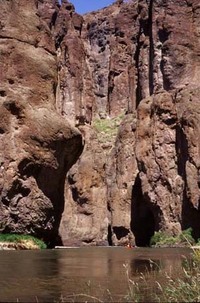
A bill is currently in the Senate that would designate 384 miles of Wild and Scenic Rivers, and 517,000 acres of Wilderness in southwestern Idaho. The primary watersheds potentially receiving protection are the Owyhee, Bruneau, and Jarbridge – all classic whitewater rivers. On September 21st, American Whitewater faxed a letter of support to Idaho Senators Mike Crapo and Larry Craig in support of the bill.
How does such a landmark conservation effort happen in Idaho?: years of hard work, vision, negotiations, and compromises by a large group of diverse stakeholders. Known as the Owyhee Initiative, this effort has been a major project for our partners at Idaho Rivers United and for many other groups. IRU worked closely with the BLM, ranchers, water users, recreationists, land-owners, and state agencies in the development of the Owyhee Initiative Agreement. Once consensus was reached, US Senator Mike Crapo brought the agreement to the Senate in the form of a bill.
Clearly this agreement and the respective bill are VERY good things for the Owyhee, Bruneau, and Jarbridge rivers which are currently subject to grazing, off-road vehicle, water withdrawals and other impacts. The new protections would respect and allow responsible grazing and limited water withdrawals, but would otherwise protect the rivers and their watersheds from mining, all dam building, off-road vehicles, and other non-wilderness compliant uses of public lands.
The downside of the issue involves several compromises that were necessary to reach consensus and get the rivers the protection they deserve. First and foremost, the boundaries of the Wild and Scenic corridors are being drawn at the high water mark rather than the standard 1/4 mile mark. This is not a resource protection issue except on the only 50 miles of river not proposed to become Wilderness. We are asking that the Wild and Scenic boundaries be expanded to protect these 50 miles of river. It is however a policy/management problem within the proposed Wilderness areas since with the narrow boundaries, the Wild and Scenic Rivers Act will not be able to function as it is intended. We have asked that this issue be corrected. Additional issues involve some grandfathered use of motors in the Wilderness Areas, release of almost 200,000 acres of potential Wilderness, and a creative solution to water rights issues that allows elimination of up to 10% of the flow during the high flow months (but protects low flows).
While we hope the bill will be improved, we are very supportive of the Owyhee Initiative, the process that lead to its development, and the bill itself.
Please consider contacting your state’s Senators with your support and concerns – right away!
To learn more and see maps of the Owyhee Initiative, check out: http://www.owyheeinitiative.org
Check out some of the incredible whitewater rivers up for protection:
Owyhee River: http://www.americanwhitewater.org/content/River/detail/id/580/
Bruneau River: http://www.americanwhitewater.org/content/River/detail/id/533/
Jarbridge River: http://www.americanwhitewater.org/content/River/detail/id/561/
NF Owyhee: http://www.americanwhitewater.org/content/River/detail/id/582/
SF Owyhee: http://www.americanwhitewater.org/content/River/detail/id/583/
EF Owyhee: http://www.americanwhitewater.org/content/River/detail/id/581/
Deep Creek: http://www.americanwhitewater.org/content/River/detail/id/551/
WF Bruneau: http://www.americanwhitewater.org/content/River/detail/id/535/
Sheep Creek: http://www.americanwhitewater.org/content/River/detail/id/625/
Battle Creek: http://www.americanwhitewater.org/content/River/detail/id/514/
Below is the letter we sent to Senators Crapo and Craig:
The Honorable Senator Mike Crapo
239 Dirksen Senate Building
Washington D.C., 20510
The Honorable Larry Craig, Chairman
Subcommittee on Public Lands and Forests
Committee on Energy and Natural Resources
364 Dirksen Senate Office Building
Washington, DC 20510
Re: The Owyhee Initiative, S. 3794
September 21st, 2006
Dear Senators,
I am writing in support of the Owyhee Initiative on behalf of American Whitewater. American Whitewater is a national non-profit organization dedicated to protecting and restoring our nation’s whitewater resources, while enhancing opportunities to enjoy them safely. Our organization is supported by over 6,800 active members and 110 affiliate clubs, which represent an estimated 80,000 citizens nationwide. Our members are primarily non-commercial, whitewater paddlers, many of whom live in Idaho or travel to Idaho for the purpose of whitewater boating.
Our members will travel great distances to traverse wild river canyons like those found on the Owyhee, Bruneau, and Jarbridge rivers. When adequate flows exist, these rivers offer spectacular recreational opportunities for paddlers seeking adventure and stunning scenery. Indeed, these rivers and their canyons are among Idaho’s – and the entire country’s – premiere whitewater boating destinations.
American Whitewater staff, volunteers, and members have closely followed the process that lead to the final Owyhee Initiative Agreement and its respective bill in the Senate. We are deeply impressed with both the process and the result. The Owyhee Initiative is an ambitious endeavor that, if successful, will result in the protection of natural resources and recreational opportunities that are of critical importance to our membership. Both Wilderness and Wild and Scenic designations directly benefit whitewater paddlers by protecting the places and experiences we find most valuable. We are deeply appreciative of your efforts in taking this issue to the Senate.
While we support S. 3794 and the process that lead to its development, we do have two significant concerns with the legislation as currently drafted.
First and foremost, we understand that there are about 50 miles of rivers proposed for Wild and Scenic designation that would lie outside proposed wilderness areas and would have no protective corridor. We ask that the boundaries of the proposed Wild and Scenic river reaches that are not in proposed Wilderness be expanded to standard widths. In this manner the Wild and Scenic Rivers Act will be able to function as intended, and the rivers’ outstanding remarkable values will be protected for future generations.
Secondly, for rivers found inside proposed wilderness areas, we believe the Wild and Scenic boundaries are too limited to protect the full suite of outstanding remarkable values as required by the Wild and Scenic Rivers Act. A simple solution to this problem would be to change the boundaries to the typical 1/4 mile limit on either side of the river, or limit the outstanding remarkable values of designation to 1) adequate flows for recreation and ecological functions, and 2) the free flowing nature of the rivers. In this manner the Wild and Scenic Rivers Act can protect instream flows and protect against dam building, while the Wilderness Act can protect the canyons themselves. The option of expanding the boundaries of the Wild and Scenic corridor would be preferable to us, but may not work for other stakeholders.
With great respect for the process that has lead to the Owyhee Initiative and the many stakeholders that participated in this process, we ask that you seek to remedy these concerns with the involvement of those stakeholders. Your leadership and support of the Owyhee Initiative is greatly appreciated by those of us who treasure paddling wild rivers. Protecting these places for future generations is a legacy for all of those involved and indeed a legacy for the incredible state of Idaho. On behalf of American Whitewater and our members, thank you for your support of the Owyhee Initiative.
Sincerely,
Kevin Colburn
National Stewardship Director