
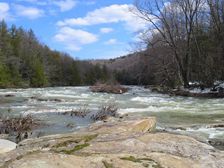
Proposed Powerline to Cross Lower Cheat Drainage
Allegheny Energy has released preliminary plans for a 210 mile long 500kv power line from Western Pennsylvania to Northern Virginia. They are applying to designate this a National Interest Energy Transmission Corridor (NIETC), which is part of a much larger plan to increase the reliability of the grid. All three proposed alternatives cross either the Cheat or Big Sandy Rivers in Preston County. Alternative S-3 runs down the Laurel Run valley and crosses the Upper Big Sandy near its confluence. Alternative S-12 crosses the Cheat Narrows about a half-mile below the put-in. Alternative S-14 crosses further upstream, in the Seven Islands section between Parsons and St. George. Only one alternative will be actually chosen and actual construction is years away.
The Big Sandy Crossing proposed in Alternative S-3, while regrettable, does not pass through a particularly unique stretch of river. It does, however, intrude on a popular intermediate run with a remote feel. More sensitive areas include Falkenstein Falls, just upstream, and the falls and ledges of the Lower Big Sandy below Rockville. We do need to maintain streamside vegetation at this crossing, both for its scenic value and to protect water quality. Allegheny engineers lead me to believe that this could be done because lines this size routinely span 2500 feet and can span as much as 4500 feet. This allows them to cross deep valleys from ridge to ridge” eliminating the need to trim trees and shrubs in low areas. This strategy can also be used at the Cheat River crossings proposed in S-12 and S-14<
Alternative S-3 follows Laurel Run rather closely above Route 73. In one spot it cuts across two meanders! It also runs parallel to the creek for about a mile above the confluence with the Big Sandy. Laurel Run is productive trout habitat and a loss of streamside vegetation could raise summer water temperatures and destroy the fishery. I strongly suggest that this line be moved uphill, away from Laurel Run, as much as possible. Steps must also be taken to control erosion during construction and throughout the life of the line.
Allegheny Energy has begun a public scoping process, They need your feedback BEFORE DECEMBER 31ST. Their web site, www.aptrailinfo.com, has maps of all the routes. I encourage river runners to tell Allegheny Energy that you use the Cheat and Big Sandy Rivers. Ask them protect streamside vegetation at whatever river corridor they actually cross. You can send comments via email at asktrail@alleghenyenergy.com or by mail at Trail, 800 Cabin Hill Drive,Greensburg, PA 15601.
Here’s a sample letter sent in by an AW member:
To Whom It May Concern:
RE: Proposed TrAIL Project
Thank you for the invitation to comment during the proposed route decision process; however, I do object to the arbitrary and unreasonably short time window you suggest for accepting public comment on a project of this magnitude and dramatic environmental impact. Many, many thousands of citizens will be permanently impacted by any final project that may ultimately be approved, and just a handful have begun to learn of its existence. –I know, that’s the rush! J
With respect to the route decision process, which I expect will proceed regardless of the imminent deluge of challenges to the proposed project by countless stakeholder organizations and citizens, I constructively wish to offer up the following considerations. I urge Allegheny and PJM to minimize, to the maximum extent technically feasible, the siting impact on areas considered to be wild, natural and scenic. Please consider that the PA, WV, and MD tourism industries depend in large part on natural and recreational resources, which are easily devalued, if not destroyed, by industrial development and its resultant ecosystem disruption and fragmentation. Increased motorized access/abuse is likely, native flora and fauna are impacted, obviously aesthetics are devastated and the quality of the outdoor recreation experience, thus tourism, is greatly diminished.
As you know, canoeing, kayaking, rafting, hiking, fishing, outdoor photography and countless other recreational activities will be impacted by the proposed project. As a person who enjoys many of these things, I implore you to seek out, and listen to, input from environmental and river recreation organizations to provide guidance on the pros and cons of various siting alternatives, as they impact the natural resources in question.
While I appreciate Allegheny’s sense of urgency and commitment to the reliability of the electricity grid, please understand that I expect to join thousands of other citizens in challenging the underlying premise that a largely “
The proposed TrAIL project is a PERMANENT destruction of environmental and social assets, in return for incremental west-to-east transfer capability on the high-voltage grid. We will challenge the prudency of new, permanent facilities at this time, with its massive social and environmental cost, when conservation efforts and demand response have not been given any material chance to provide the extremely meaningful contributions to the reliability problem, which they clearly promise. Congress, FERC and state regulatory agencies are just now beginning to act after recognizing the powerful impact that demand side investment can achieve to avoid, or at least significantly delay or mitigate, destructive supply-side solutions. Moreover, if supply-side solutions are ultimately required, we will demand our politicians to consider cost causation and equity. That is to say, in plain words, if the eastern seaboard cities and sprawl need more power plants, let them site them in their own “backyard,” rather than burden the environment and citizens of western PA, MD and WV. TrAIL would have us pay a heavy price just to facilitate the unrelentless and glutinous growth in the consumption of energy by folks outside the region.
Sincerely,