
After another busy year in the southern Rockies, it is a great time to look back on our accomplishments and look ahead to what next year will bring. This year was full, yet again, with unprecedented challenges as well as opportunities. The first ever water shortage was declared on the Colorado River while hundreds of millions of dollars were appropriated for watershed restoration, aquatic habitat remediation and natural infrastructure in the West as a part of the Infrastructure Investment and Jobs Act. Climate change and out-dated water management makes our protection and restoration work as important as ever to ensure we have clean and healthy rivers to enjoy long into the future.
See below for a rundown of what we’ve been up to in 2021 and what we have on the horizon for 2022 in Colorado, New Mexico, Utah and Arizona:
Protect
- The Grand Mesa, Uncompahgre, and Gunnison National Forests cover nearly 3 million acres of land and thousands of river miles on Colorado’s Western Slope. The Forests include iconic whitewater rivers like Oh-Be-Joyful Creek, Taylor River Canyon, and the San Miguel River. This November, we came one step closer to protecting these rivers and creeks as eligible for Wild and Scenic River protection. Eligibility would ensure the Forest Service manages the river corridors to protect their streamflows and identified values, such as paddling. American Whitewater submitted detailed and robust comments to the Forest Service outlining why these rivers rise to the level of outstanding and we got hundreds of paddlers to speak up too. The Final Plan and eligibility findings should be released later in 2022 and we will ensure that the outcome includes protections for these high quality rivers. If it doesn’t, we will hold the Forest Service accountable during the objection process.
- On November 2, 2021 the M.H. Dutch Salmon Greater Gila Wild and Scenic River Act was reintroduced by Senators Martin Heinrich and Ben Ray Luján (NM), poised to protect 446 river miles under the Wild and Scenic Rivers Act.
- Senator Michael Bennet (CO) released draft legislative language that would establish the Dolores River Canyon from Bradfield to Little Gypsum bridge as National Conservation and Special Management Areas. This is the result of years of collaboration with local counties and water users to provide lasting protections for this impressive landscape. While the legislation does not affect flow management, it does include protections for the values established by the Bureau of Land Management in their wild and scenic suitability study, including whitewater boating.
- We are working to protect water quality on over 25 rivers and streams in the Gunnison, San Juan, and Dolores river basins. Outstanding Waters is a state designation that protects the existing high water quality of streams that have recreational and ecological significance. In November 2021, we presented to the state’s Water Quality Control Commission alongside our partners advocating for protection of these streams. A final decision will be made in June 2022.
- This July, we defeated two dams proposed on the Little Colorado River, a sacred and beloved tributary to the Grand Canyon. The dam proponent, Pumped Hydro Storage LLC cited the strong public opposition to the project in the official surrender of their permits.
- In Arizona, we ensured that the final Comprehensive River Management Plan for the Wild and Scenic Fossil Creek protected river access and the high-quality paddling opportunities that exist on the creek.
- We worked with CU Boulder’s Master of Environmental Management Program to develop a path forward for permanent river protections in Colorado.
Restore
- As a result of AW’s participation on the low head dam steering committee convened by Colorado Department of Natural Resources, we have been able to utilize the dam inventory and are working on establishing a portage route and signage around a dangerous structure on the Rio Grande.
- In the new year we will continue to work with DNR and other partners to prioritize low head dam removal or retrofit projects that would address public safety concerns, recreational experience and habitat connectivity.
Enjoy
- The prior appropriation doctrine of water governance in many western states indicates that the first “beneficial use” of water has the first right to utilize water. Those first uses, like mining and agriculture, are typically consumptive and remove water from the stream. Since the 1970s, Colorado has identified the benefit to instream flows for the environment and in 2001 established recreational uses as beneficial when taking place at a whitewater park. Over the past year we have been working on new legislation that would provide a tool for communities to enhance flows allowing for increasingly broader and more inclusive recreational uses of rivers across the state. River recreation is an important economic driver in many Colorado communities. This bill will provide a way for communities to ensure that the economy is sustainable even in a drier future. We expect to run a bill in the legislative session coming up in the new year.
- American Whitewater is developing a method to determine the economic impact of river-based recreation and its sensitivity to water supply changes. This method will pair with our established recreational Flow Preference and Boatable Days tools. By understanding the basin specific economic impact of a boatable day, we can utilize this framework to quantify the dollar value costs and benefits of water management decisions. Resulting data could be used by communities making decisions about how to support their river recreation economy. For this pilot study we are analyzing economic impacts from recreation on the Yampa, Crystal, Roaring Fork, and Cache La Poudre Rivers. For this work we completed flow studies on the Poudre, Crystal and Roaring Fork this past year.
- Our work is ongoing to secure public access to rivers in New Mexico. Just last month we finally had hearing dates set by the New Mexico Supreme Court on the case to determine the constitutionality of a NM Game and Fish Commission rule allowing the application of non-navigable waters by private landowners. Oral arguments will be heard on March 1st, 2022.
Thank you to all our members and supporters for your ongoing encouragement and commitment to protecting and restoring these amazing places we all care so much about. Our work is not possible without you. Have a wonderful holiday season and do your snow dances!
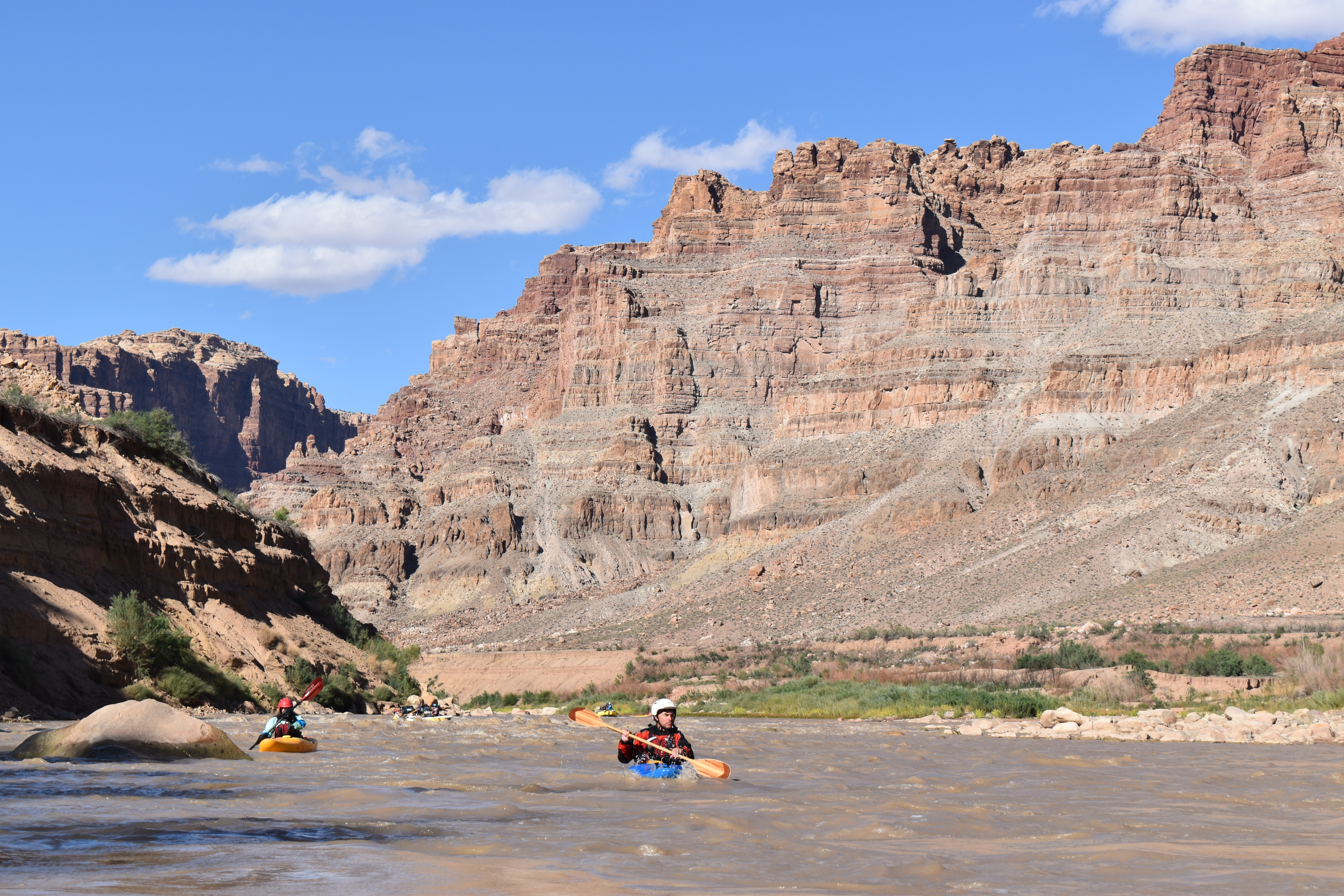
Photo credit: Hattie Johnson; the returning Gypsum Canyon rapid in Cataract Canyon