
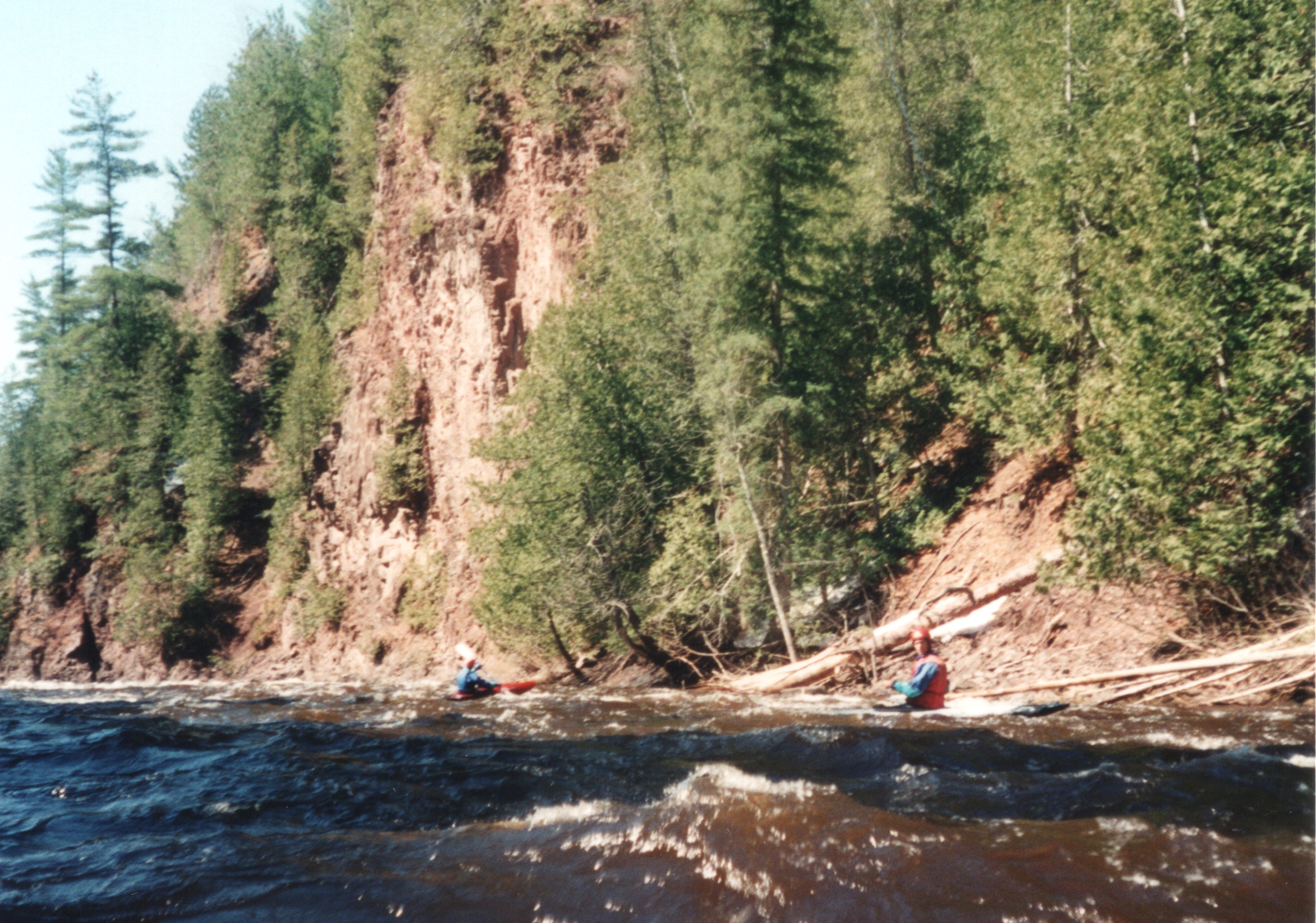
The Montreal River forms part of the border between Wisconsin and Michigan and is one of the most celebrated whitewater rivers in the Upper Midwest. Two hydropower facilities, the Superior Falls and Saxon Falls projects, regulate flows on the mainstem of the Montreal river, while the Gile Flowage storage reservoir on the West Branch Montreal influences flows on this tributary as well as downstream conditions in the main canyon. Together, these facilities shape when, how often, and at what quality whitewater recreation occurs on a river that has drawn paddlers for generations.
Below the Saxon Falls powerhouse, the river drops into the Montreal Canyon, a deep bedrock gorge with continuous rapids, towering cliffs, and striking scenery. Guidebooks and paddling histories describe this run as one of the most prized in the Northwoods for intermediate boaters. Boating conditions in the canyon are highly dependent on project operations, and recent flow evaluations confirm that desirable paddling opportunities generally occur in a broad range of moderate to high flows. At very low flows the canyon is largely unrunnable, while increasing flows transform it into a powerful, continuous whitewater experience that attracts skilled paddlers from across the region.
Upstream, releases from the Gile Flowage create whitewater opportunities on the West Branch Montreal River and contribute to flows in the mainstem canyon hours later. Studies and boater surveys have shown that the West Branch also supports high-quality recreation across a defined range of flows. Because all three facilities operate as an interconnected system, coordinated river management is essential to maintain and enhance whitewater opportunities throughout the basin.
Access to the Montreal Canyon is provided by a tailwater entry below Saxon Falls and a take-out near Superior Falls. These access points have served paddlers for decades, but the relicensing of these projects offers an opportunity to improve safety, clarity, and functionality for modern use. American Whitewater is working to ensure that access infrastructure, signage, and safety features meet current best practices while preserving the rugged character of the canyon experience. Reliable real-time flow information is equally important. Modern web-based flow reporting allows boaters to plan trips safely and reduces unnecessary risk, and American Whitewater is advocating for public flow information systems that integrate directly with widely used river condition platforms.
For American Whitewater, the Montreal River represents both a premier recreational resource and a conservation priority. Our work on this river focuses on securing river flows that support quality whitewater experiences, ensuring public access that is safe and sustainable, and promoting coordinated operation of hydropower facilities so that energy production, fisheries, and recreation can coexist. The current licensing cycle will determine river management for decades to come, making this a pivotal moment to protect the character of the Montreal Canyon and the West Branch Montreal for future generations of paddlers.
American Whitewater has been engaged on the Montreal River for more than thirty years and continues to work with agencies, the hydropower operator, and local stakeholders to achieve balanced river management. Our goal is straightforward: to keep this remarkable whitewater river accessible, runnable, and thriving, while ensuring that hydropower operations respect the public’s enduring connection to the river.