
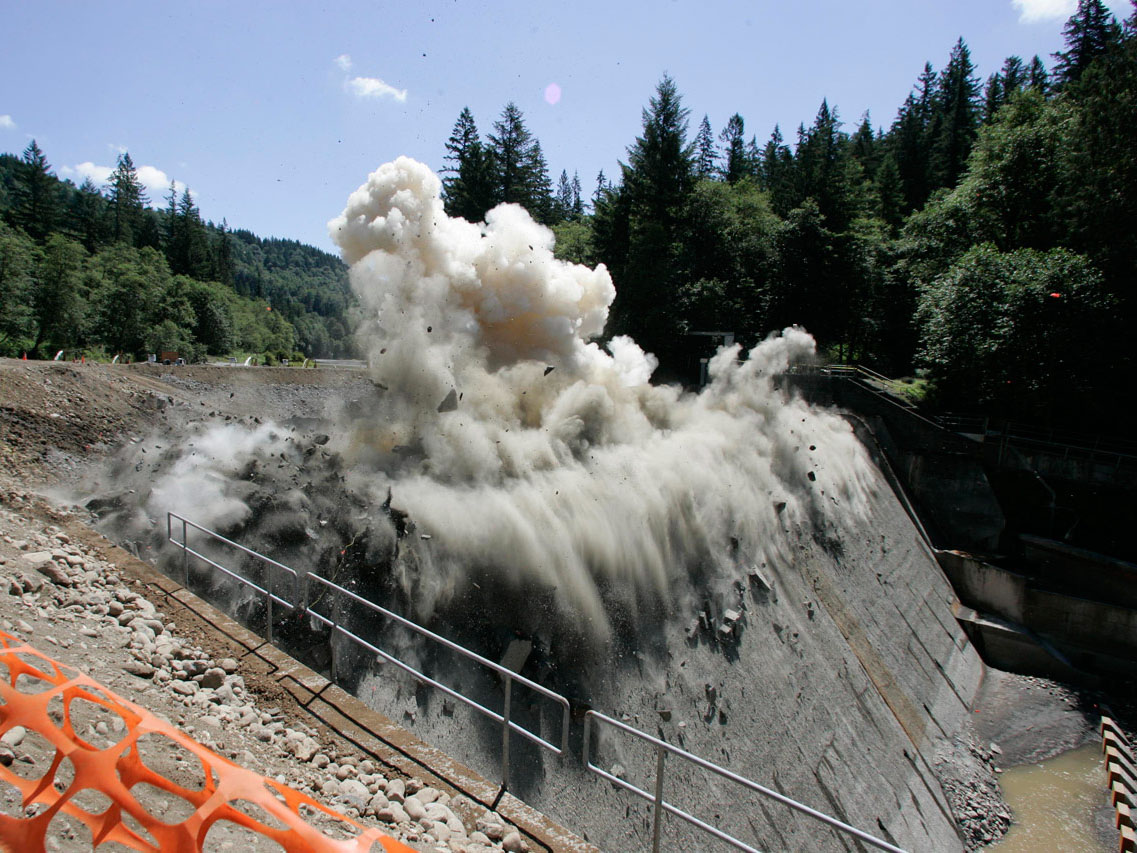
The removal of Marmot Dam on the Sandy River was completed in 2007, restoring the river to a free-flowing state. American Whitewater continues to advocate for projects that enhance public enjoyment of the river through ongoing conservation efforts and established public access.
The Sandy River Gorge has the feel of a remote canyon, yet it lies just half an hour from downtown Portland. Its gorge walls reveal a living textbook of the region’s geologic history, and ancient trees still line the riverbanks. Organizations such as The Nature Conservancy and Western Rivers Conservancy have been key community partners in protecting lands along the river. A broad coalition, including American Whitewater, worked with local utility Portland General Electric on a plan to remove Marmot Dam. This dam had diverted flows and blocked salmon migration for many decades. American Rivers, Trout Unlimited, and Water Watch of Oregon were critical partners in achieving our shared goal of restoring the river.
The Sandy River is a unique treasure for the greater Portland area. Following the removal of Marmot Dam in the summer of 2007, it became one of the most intact river ecosystems near a major metropolitan area. The agreement to remove the dam and decommission the hydropower project was signed on October 24, 2002, by Oregon Governor John Kitzhaber—who supported the removal from the start—along with eight federal and state agencies and 13 organizations, including American Whitewater.
Implementation of this agreement has provided upstream passage for threatened Chinook Salmon, Steelhead, and Bull Trout and preserved 5,000 acres along 15 miles of river for wildlife and public recreation. Dam removal also extended the boating season on the Class III-IV Sandy Gorge by restoring the 400–600 cfs that had been diverted for power generation. Additionally, it allows a continuous 12.5-mile trip from Marmot Bridge to Revenue Bridge without requiring a portage around the dam.
Key Documents Filed with the Federal Energy Regulatory Commission:
Selected Research
- Major, J. J., O’Connor, J. E., Podolak, C. J., Keith, M. K., Grant, G. E., Spicer, K. R., Pittman, S., Bragg, H. M., Wallick, J. R., Tanner, D. Q., Rhode, A., & Wilcock, P. R. (2019). Geomorphic response of the Sandy River, Oregon, to removal of Marmot Dam (USGS Professional Paper 1792). U.S. Geological Survey. <https://doi.org/10.3133/pp1792>
- Major, J. J., Spicer, K. R., Rhode, A., O’Connor, J. E., Bragg, H. M., Tanner, D. Q., Anderson, C. W., Wallick, J. R., & Grant, G. E. (2011). Initial fluvial response to the removal of Oregon’s Marmot Dam. Eos, Transactions American Geophysical Union, 89(27), 241–242. <https://doi.org/10.1029/2008EO270001C>
- Parks, Noreen; Grant, Gordon. 2009. A ravenous river reclaims its true course: the tale of Marmot Dam’s demise. Science Findings 111. Portland, OR: U.S. Department of Agriculture, Forest Service, Pacific Northwest Research Station. 5 p