
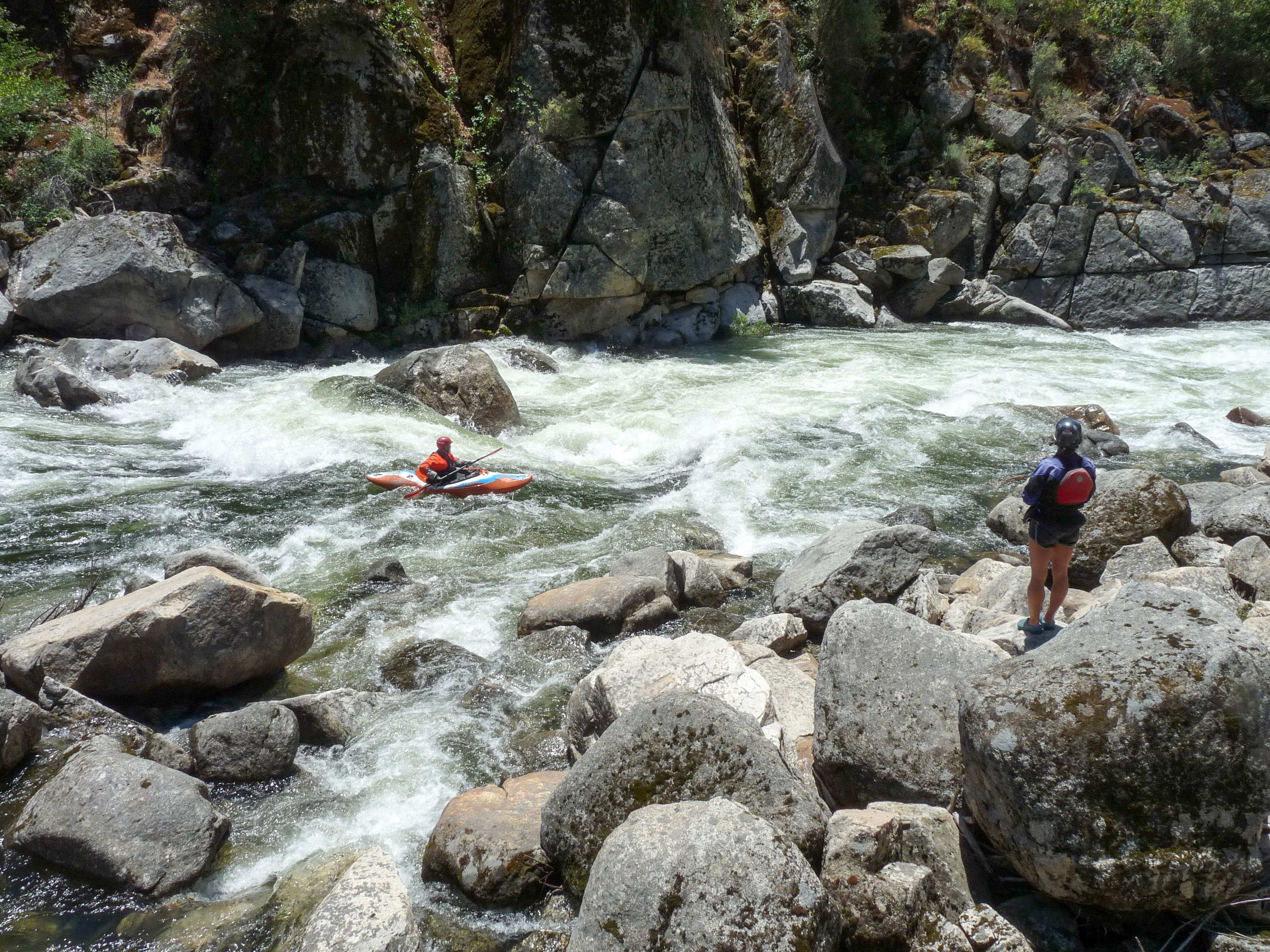
The San Joaquin River is one of California’s most significant whitewater rivers, flowing from the high Sierra Nevada through the steep granite walls of the San Joaquin River Gorge Special Recreation Area. It is also one of the most intensively developed hydropower rivers in the state. For over two decades, American Whitewater has worked to restore functional river flows that serve both whitewater recreation and river ecology, while also protecting the river’s remaining free-flowing reaches from further degradation. Together, these efforts reflect a single, integrated goal: keeping the San Joaquin a living river.
Whitewater Recreation
The San Joaquin River’s whitewater character shifts markedly from its largely free-flowing headwaters to its managed hydropower reaches downstream. In the high Sierra, the Middle Fork San Joaquin River at Devils Postpile flows through a volcanic landscape shaped primarily by snowmelt-driven seasonal hydrology, where timing and duration of flows reflect natural runoff patterns.
Downstream of Mammoth Pool Reservoir, however, the river enters a series of highly regulated canyon reaches—including the Chawanakee Gorge, Horseshoe Bend, and three outstanding runs within the San Joaquin River Gorge Special Recreation Area—where whitewater conditions depend on hydropower operations rather than natural inflow alone. Across these regulated reaches, safe and functional whitewater depends not just on the presence of water, but on how it is released: gradual ramping, sufficient duration, and predictable timing. American Whitewater has consistently emphasized that these managed flow characteristics are inseparable from ecological function—flows that mimic a natural hydrograph rising and falling in controlled, river-like patterns, are the same flows that support sediment transport, channel stability, aquatic habitat, and public safety.
Forest Planning and Wild & Scenic River Eligibility
Since 2013, American Whitewater played a sustained and influential role in the Sierra and Sequoia National Forest planning processes ensuring that California’s whitewater rivers—including key reaches of the San Joaquin River—were properly evaluated for eligibility under the Wild and Scenic Rivers Act and recognized for their outstandingly remarkable value (ORV) of recreation.
Through technical submissions, field-based documentation, and coordinated public advocacy, American Whitewater worked to correct early draft plans that omitted or failed to evaluate whitewater resources. This effort resulted in the Sierra Sequoia National Forest Land Management Plans that include and protect major San Joaquin River reaches in the Wild and Scenic eligibility inventory, including the Middle Fork San Joaquin River from Devils Postpile National Monument to Mammoth Pool Reservoir, the South Fork San Joaquin River from Florence Lake to Mammoth Pool, and the San Joaquin River through the Chawanakee Gorge, Mammoth Pool, and Horseshoe Bend.
These reaches were recognized for recreational ORVs associated with nationally significant whitewater boating, alongside scenic, geologic, and ecological values. Under the Wild & Scenic Rivers Act, this eligibility requires the Forest Service to protect the rivers’ free-flowing character and ORVs unless and until Congress acts on designation, ensuring that these iconic San Joaquin River segments remain protected from new dams, diversions, and incompatible development.
Hydropower & Flow Restoration
After a new federal license was issued in 2003 for Southern California Edison’s Big Creek 4 Hydroelectric Project, American Whitewater began focused work to improve how the San Joaquin River flowed below Redinger Dam. The goal was simple: make the river act more like a river again. Rather than accepting erratic releases or treating recreation and ecology as side issues, this work focused on changing everyday operations so water levels rose and fell in more natural, predictable ways. Over time, that effort led to a shared operations agreement that restored reliable flows and integrated beneficial flows into normal project operations that create consistent boating opportunities and healthier river conditions year after year.
A watershed-scale approach followed in 2007 when American Whitewater signed onto the Big Creek Settlement Agreement, which consolidated four separate hydroelectric licenses—covering more than twenty reservoirs, forebays, and diversions—into a single coordinated framework. This made it possible to address flow restoration comprehensively rather than project by project.
American Whitewater’s most active work on the San Joaquin today is focused on the Kerckhoff Hydroelectric Project, located squarely within the San Joaquin River Gorge Special Recreation Area and operated by Pacific Gas and Electric Company. The Kerckhoff Project directly affects three outstanding whitewater reaches and heavily used public lands managed by the Bureau of Land Management.
American Whitewater is an intervenor in the ongoing relicensing proceeding and has submitted extensive technical and legal comments addressing public safety, recreational boating days and recreation access. This work documents that sudden, extreme flow fluctuations below Kerckhoff Dam—particularly during planned outages—pose a serious and well-documented hazard to the recreating public in the Gorge.
Ongoing Collaboration with the North Fork Mono Tribe
American Whitewater’s work on the San Joaquin River is actively grounded in ongoing collaboration with the North Fork Mono Tribe. The river and gorge remain central to Tribal cultural identity, traditional practices, and stewardship responsibilities, and Tribal perspectives continue to inform present-day river management.
Working together, American Whitewater and the Tribe advance flow restoration that reflects living river processes, supports native species and habitats, and respects the river’s cultural significance. This partnership integrates Tribal knowledge, ecological science, and recreation expertise to advocate for flow patterns aligned with natural seasonal variability—benefiting fish, riparian ecosystems, whitewater recreation, and cultural uses simultaneously.
Protecting the San Joaquin River Gorge from a New Dam
Flow restoration alone is not enough if the river itself is lost. American Whitewater also actively engages in protecting the San Joaquin River Gorge from new dam construction, including the long-standing proposal for Temperance Flat Dam. The Gorge is a rare, low-elevation Sierra Nevada river corridor flowing through public lands, supporting whitewater boating, hiking, wildlife habitat, and cultural resources.
Federal land managers have found substantial portions of the Gorge eligible and suitable for Wild and Scenic River designation, recognizing its outstanding recreational, scenic, cultural, and ecological values. Permanent protection of the Gorge is an essential goal to ensure that restored flows continue to move through a free-flowing canyon rather than a reservoir.
Stewardship and the Future of the San Joaquin
The San Joaquin River tells a continuing story of persistence and partnership. Through post-license flow restoration, collaboration with Tribal partners, defense of the San Joaquin River Gorge from new dams, and active engagement in the Kerckhoff relicensing, American Whitewater continues to demonstrate that hydropower rivers do not have to choose between ecology, recreation, and public safety.