
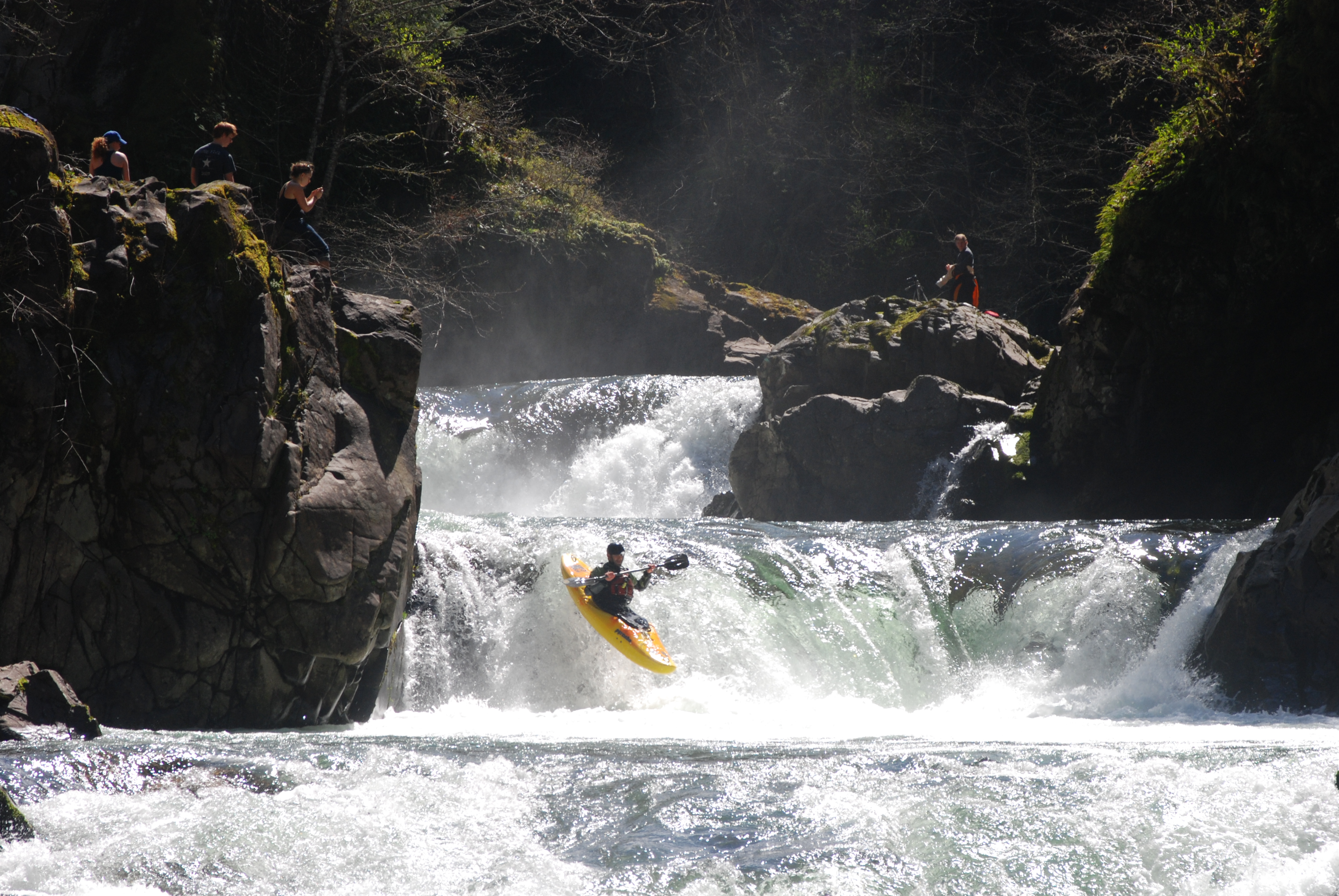
Canyon Creek is one of the most spectacular whitewater runs in southwest Washington attracting paddlers to an incredible diversity of rapids packed into the short run from Fly Creek to Merwin Reservoir. Paddlers living in Portland and Vancouver are lucky to have this backyard gem which can be enjoyed after work or even before work for a “breakfast run.” Consistent flows, easy access, the scenic beauty of the canyon, and high quality rapids make this creek a popular destination for locals as well as visitors from across the country and even overseas. Each spring those competing for title of fastest paddler down Canyon Creek can be found at the annual Canyon Creek Race, historically one of the most well-attended creeking races in the country.
Runs on Canyon Creek start as high as Pelvey Creek in the Gifford Pinchot National Forest. On these upper reaches of the creek, rapids are more widely spaced but it’s still a great section of river. Most come for a shorter section with the highest density of rapids starting at Fly Creek. This section flows through private timber land, but past harvest activity is generally not apparent from the creek which is well screened by vegetation that clings to the steep canyon walls. The real threat to this creek has been hydropower development.
Hydropower
On September 12th, 1991 Walter Musa obtained a water right (Control Number S2-28278) for hydropower development on Canyon Creek and on December 30th, 1994 Mr. Musa filed a formal preliminary permit application for the project (FERC P-11513). Constructing this project would destroy a good part of the run with a dam at 45.9423, -122.3445 and a powerhouse at 45.9522, -122.3476. American Whitewater formally filed for intervention in the proceeding. Soon thereafter FERC issued a preliminary permit allowing Mr. Musa to investigate feasibility of the site.
Local boaters rallied and American Whitewater Regional Coordinator Andrew Wulfers helped spread the word (see the May/June 1995 issue of the American Whitewater Journal). Technical assistance was provided by American Whitewater’s first Conservation Director Rich Bowers who was responding to a flurry of preliminary permits threatening whitewater runs across the country and received support for this work from a Conservation Alliance grant in 1993. American Whitewater board member Brooke Drury, based in Seattle, also took a leadership role and several other organizations including American Rivers, Clark-Skamania Flyfishers Association, Gifford Pinchot Task Force, Oregon Kayak and Canoe Club, Rivers Council of Washington, and The Mountaineers all joined the fight to keep this creek free-flowing.
Andrew organized the first Canyon Creek Race and Rodeo and helped raise visibility of the hydropower threat. Businesses that stepped up to sponsor this first event, that continued for many years, included Alder Creek Kayak and Canoe, All Star Rafting and Kayaking, Kavu, Orosi, Patagonia, and Perception Kayaks.
It soon became apparent that Mr. Musa had applied for a preliminary permit to claim a site while waiting for conditions to become economically favorable for development of the project. This is known as site banking and is not legal. On December 18, 1997 FERC canceled the preliminary permit for this project. Brooke Drury reported that the Canyon Creek Hydropower Proposal was now “Dead in the Water” (see the March/April 1998 isuse of the American Whitewater Journal). While there are no current plans to develop hydropower on this creek, there is always a chance that a new application could emerge.
The best way to protect this creek would be through the Wild and Scenic Rivers Act. Canyon Creek is probably the highest value recreation resource for whitewater boating of any of the rivers in the Lewis or Cowlitz drainage. Given the recent hydropower proposal on this creek the boating community continues to remain concerned over the future of this spectacular run.
Access
Runs on Canyon Creek end with a paddle out on Merwin Reservoir. During the relicensing of the Lewis River hydropower projects, American Whitewater worked with PacifiCorp to evaluate potential alternatives for take-out access. While no other sites offered reasonable public access, we requested that PacifiCorp address erosion concerns and improve the steep, muddy climb from the reservoir. In response, the Federal Energy Regulatory Commission (FERC) incorporated our request into the new project license, requiring PacifiCorp to formalize and maintain the existing take-out access on Merwin Reservoir.
An ongoing issue remains at the put-in, located on private timberlands owned by Weyerhaeuser. For many years, the company allowed informal public use at the Forest Road 54 crossing of Canyon Creek, but in recent years it has moved to restrict parking and river access at this location.
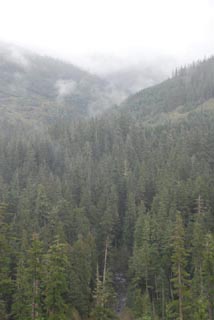
The upper section of Canyon Creek as it flows through the Gifford Pinchot National Forest.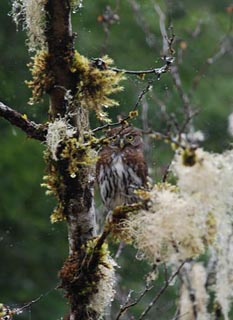
A pygmy owl stands watch over Canyon Creek at Twin Bridges.