
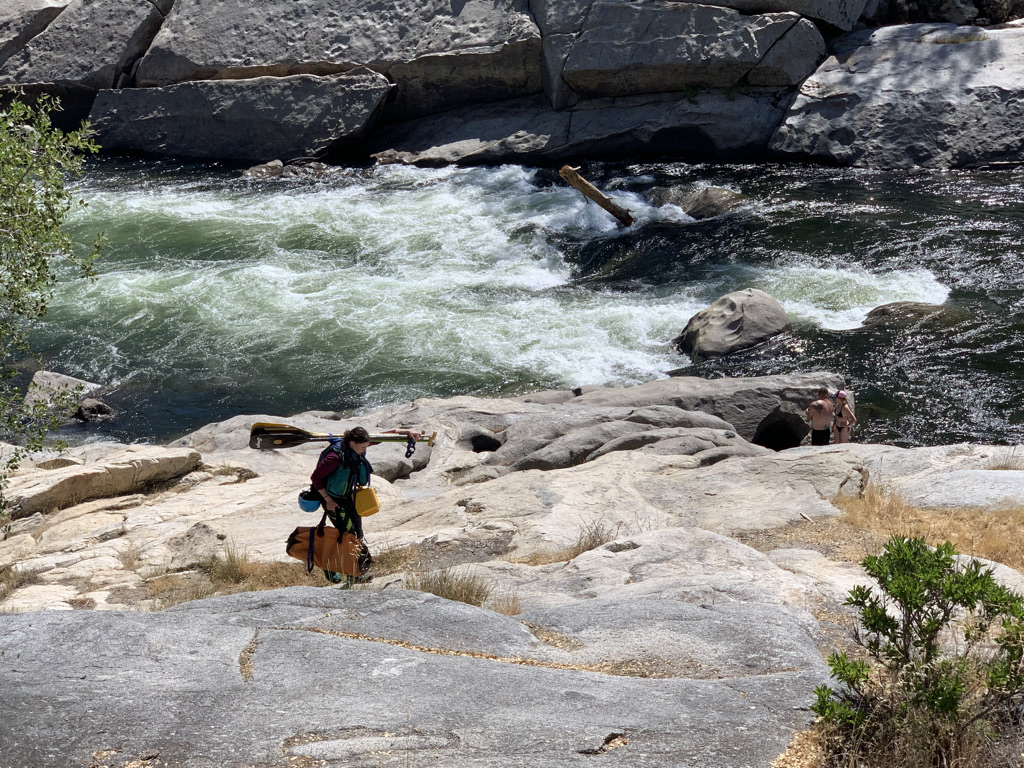
After nearly a decade of advocacy by American Whitewater and our partners, a final water quality certification for the San Joaquin River Gorge has been issued that benefits recreation, public safety, and the river’s health. Less than an hour from Fresno, the San Joaquin River Gorge Special Recreation Area is a place where people connect with the outdoors and experience dramatic canyon scenery, challenging rapids, and rich natural resources. This summer, the future of this experience became a little brighter.
The California State Water Resource Control Board (SWRCB) finalized the water quality certification for Pacific Gas & Electric’s Kerckhoff Hydroelectric Project that includes annual whitewater boating opportunities, improved river access and communication, better coordination among the hydropower facilities that influence flows through the river corridor, and, most importantly, stronger safety protections for the public.
At a time when California’s authority over state water resources has faced repeated challenges through federal legislation and regulatory proposals, this outcome provides a powerful example of why maintaining the state’s ability to protect rivers under the Clean Water Act is so important. States need strong tools available for maintaining and enhancing the water quality in rivers and the public benefits rivers provide.
While most people may not be aware of Section 401 of the Clean Water Act, its importance can not be overlooked. The law gives California and all states a voice when major federally licensed projects affect our rivers and streams. It is the main law that allows states to require measures that protect public values such as recreation, public safety, fisheries, water quality, and other beneficial uses of water.
Whitewater Recreation Recognized as a Valuable Use of the River
One of the most visible accomplishments codified in the water quality certification is the establishment of annual whitewater boating opportunities in the San Joaquin River Gorge. For boaters, these releases represent much more than days on a calendar. They affirm that whitewater recreation is a legitimate and important use of the San Joaquin River and that access to outstanding boating experiences deserves consideration when decisions are made about how the river is managed.
Equally important, the certification includes an adaptive management framework that recognizes that recreation opportunities should not remain static. Proposed federal recreation conditions had a focus on reducing boating opportunities when use targets were not met, while the state certification now requires a pathway to increase boating days when use numbers support adding additional releases and other public benefits. This distinction matters. Rather than treating whitewater recreation as a fixed obligation that can only be scaled back, the certification recognizes that recreation opportunities may grow over time as project operations, coordination among facilities, and river management practices improve.
Public Safety as a Core River Value
While annual boating opportunities are a significant achievement, the most important outcome may be the certification’s public safety protections. Throughout the relicensing process, American Whitewater consistently raised concerns about quickly rising or dropping river flows and the risks those changes can create for people recreating downstream. Boaters are often the first to notice these issues, but they affect everyone who uses the Gorge, including anglers, hikers, swimmers, campers, and families enjoying the river corridor.
The final certification addresses public safety by requiring project operations to target a ramp-up rate of no more than one foot per hour below Kerckhoff Dam when flows increase from minimum releases to higher flows. This requirement is intended to reduce the speed at which river levels rise, providing the public with more time to recognize changing conditions and move to safety when necessary. Importantly, the certification focuses on managing the hazard itself rather than relying exclusively on signs, sirens, or notifications. The safest river operations are ones where dangerous conditions are prevented whenever possible, not simply ones where people are warned after conditions begin to change.
Why Section 401 Matters
The annual boating opportunities, public safety protections, fisheries benefits, access improvements, and coordinated management provisions included in the certification for the San Joaquin River Gorge did not happen simply because stakeholders requested them. They exist because California had the authority to require them. Section 401 of the Clean Water Act gives states a critical role in protecting rivers affected by federally licensed projects. It allows states to require measures necessary to protect beneficial uses of water, including recreation, fisheries, public safety, water quality, and other public values.
Sadly, California and all states’ authority to protect their water and beneficial uses is increasingly under threat. Senate Bill 4944, introduced and advanced by Senator Armstrong as part of broader energy permitting reforms, would significantly narrow state authority under Section 401 by limiting the scope of state review and restricting states’ ability to address impacts to beneficial uses beyond a narrow interpretation of water quality. At the same time, the Environmental Protection Agency has proposed additional changes to Section 401 regulations that could further constrain state authority to require protections for our rivers.
Supporters characterize these proposals as permitting reform. The San Joaquin River Gorge demonstrates what they mean on the ground. Without strong Section 401 authority, California would have far less ability to secure annual boating opportunities, require public safety measures, improve project coordination, and ensure that recreation and fisheries receive meaningful consideration.
The San Joaquin River Gorge certification is more than the conclusion of a relicensing milestone. It is a reminder that healthy rivers do not protect themselves—they are protected by laws that recognize their value and by people willing to participate in the process. American Whitewater remains committed not only to implementing these protections in the Gorge, but also to defending the Clean Water Act authorities that made them possible.
You can read the final water quality certification below or check it out at the California State Water Resources Control Board page.
Photo: The image at the top of the article shows the take-out, right where the study showed a rapid rise of 10-12 feet stage height change could occur– and that if those conditions were allowed to continue and happened while the people pictured were there, the couple in the far right corner of the picture would likely be swept away.