
Texas Outfitters, Businesses Urge Cornyn, Cruz, Abbott to Protect River Access, Halt Border Construction
Barriers Planned for Rio Grande Access Threaten Rural Recreation-Based Economy
TERLINGUA, Texas— More than 140 outfitters, local businesses and recreation groups today urged Sens. John Cornyn and Ted Cruz and Gov. Greg Abbott to protect public access to the Rio Grande and oppose Customs and Border Protection’s (CBP) plans to build steel border barriers across nearly every river access point along the Rio Grande Wild and Scenic River through Big Bend National Park.
The groups warned that closing river access and building permanent barriers and roads through the canyon corridor would devastate the region’s recreation economy, threaten local businesses and prevent visitors from experiencing one of America’s most iconic wilderness rivers. Signatories include regional river and hunting outfitters, national brands including Patagonia, and organizations including Access Fund, American Whitewater, Outdoor Alliance and Texas Backcountry Hunters and Anglers.
“Generations of Texans have built their lives and businesses around the Rio Grande, but these plans would threaten it all” said Billy Bartko, owner of Far Flung Outdoor Center. “To officials in Washington D.C., this is just another construction project. But to all of us in West Texas, it’s a matter of our survival. Our economy depends on access to the Rio Grande. We can protect the border without sacrificing our local businesses and Texas’ natural heritage. We are urging our Senators and Governor to step in and stop this project before it destroys our livelihoods.”
CBP’s current plans call for vehicle barriers at nearly every river access point along the Rio Grande Wild and Scenic River, including Lajitas, Talley, Solis, La Linda and Dryden Crossing. The letter warns that this would effectively end commercial and recreational river running in Big Bend National Park while providing no clear border security benefit. CBP’s plans for vehicle barriers include remote walled canyons where no unauthorized vehicle crossings have been documented — and in most cases, where no vehicle access from Mexico exists at all.
“Our local businesses depend heavily on tourism from the outdoor recreation economy,” said Sara Ryza with the Big Bend Tourism Alliance. “Every room booked, meal ordered and gas tank filled keeps our regional economy going. Cutting off access to the Rio Grande and destroying the most beloved stretches of Big Bend National Park would directly threaten the businesses and communities that depend on visitors experiencing Big Bend. Our elected officials must act before it’s too late.”
In 2024, Big Bend National Park drew 561,459 visitors, who spent an estimated $56.8 million in surrounding communities and generated $63.7 million in total economic output for the region. According to the Office of the Texas Governor, travelers to the Big Bend region contribute $4.6 billion in inflow spending. This sustains thousands of jobs including guiding, lodging, food service, retail, logistics, equipment rental, grocers and builders while contributing significantly to the local tax base.
“Big Bend is an iconic boating destination with sweeping cliffs and awe-inspiring scenery,” said Kestrel Kunz, Southern Rockies Protection Director with American Whitewater. “Every year, Americans travel from afar to explore the Rio Grande, supporting the economy in rural west Texas. The proposed border barrier construction could cut off access to the Rio Grande entirely. The American public deserves transparency on the future of Big Bend and assurance that access to the river will be protected, including for the public, outfitters, and search and rescue operations.”
On June 9, 2026, the Department of Homeland Security waived nearly every environmental, public health and cultural resource protection law to fast-track construction in Big Bend National Park — the first time such waivers have been applied inside a national park. This waiver also stripped Texas and its counties of authority to enforce their own state and local laws.
Opposition to the project spans the political spectrum. All five sheriffs in the Big Bend border region have opposed barrier construction, noting that the region’s mountains, canyons, desert and Rio Grande already form a formidable natural barrier. All 14 Texas border county judges have requested greater transparency and border security approaches suited to the terrain. Seven former Big Bend National Park superintendents have urged DHS to reject the waivers. On Friday, the Texas Land Commissioner sent a cease-and-desist order to CBP and federal contractors for illegally clearing state land for border wall construction.
Big Bend Sector covers 517 miles of border where no unauthorized vehicle crossings have been documented — more than a quarter of the entire U.S.-Mexico boundary — but saw just 1.3% of total border apprehensions in 2025. Inside the park itself, that figure drops to 0.045%. For decades, the National Park Service and CBP have conducted effective border enforcement while preserving Big Bend’s irreplaceable natural heritage and outstanding opportunities for outdoor recreation.
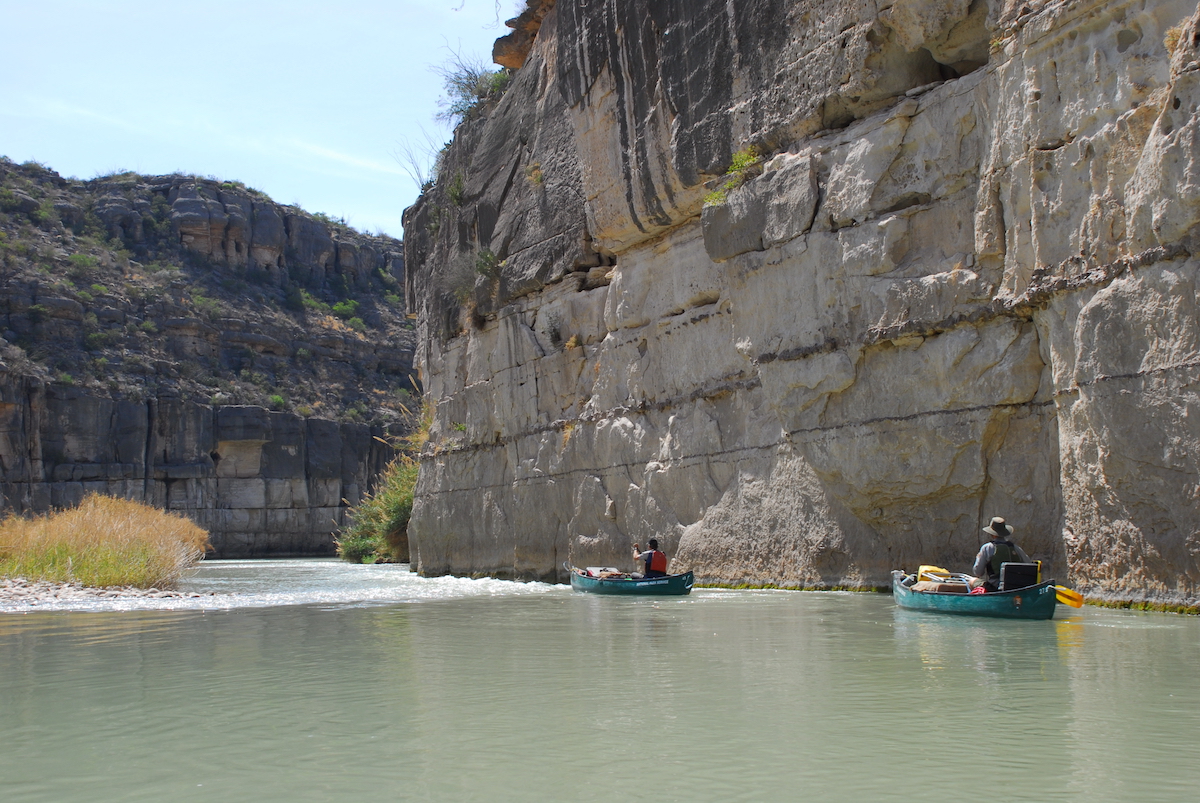
Photo by Tom O’Keefe
Far Flung Outdoor Center is a locally owned outdoor recreation and hospitality business based in Terlingua, Texas, near Big Bend National Park. For decades, Far Flung has introduced visitors to the Big Bend region through guided Rio Grande trips, Jeep and ATV tours, lodging, star parties, and other outdoor experiences.
The Big Bend Tourism Alliance is a coalition of more than 100 local businesses working to support the region’s tourism and outdoor recreation economy and the communities, jobs and livelihoods that depend on visitors experiencing Big Bend.
American Whitewater is a national non-profit river conservation organization founded in 1954 with approximately 7,000 members and 85 local-based affiliate clubs, representing whitewater enthusiasts across the nation