
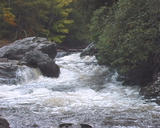
The USFS issued a Record of Decision on Tuesday, January 20th 2004 that maintains the ban on paddling the Wild and Scenic Headwaters of the Chattooga River.
In doing so the USFS has begun a bad public policy of zoning paddlers away from anglers, based on the absurd assumption that the two uses are incompatible. This policy could ultimately result in both anglers and paddlers losing access to rivers they cherish, but for now the decision simply discriminates against paddlers.
Thankfully, it appears obvious that the USFS made this arbitrary decision based on little or no actual data and on faulty premises.
American Whitewater will be formally appealing this decision.
The USFS responded to the significant public comments requesting that the ban be lifted, by proposing the following basic justifications. We offer a very brief initial informal response to each of these points based on a perfunctory read of their “analysis” and our extensive research. Note that a more detailed “formal” analysis of this decision will follow in several days.
1. Environmental Impact: The USFS itself states that there will be no significant environmental impact associated with paddling, while supporting shore-based fishing, which necessarily causes more vegetative and soil damages than paddling due to a process the USFS calls “SOcial Trailing”.
2. Preservation of solitude and sense of place of other recreationists: This is a discriminatory policy. The mere suggestion that a fisherman or hiker deserves solitude and a sense of place more than paddlers, or that paddlers somehow impact other’s sense of place is unfounded and unethical. There would be very limited interaction between paddlers and other recreationists since the trails in the area seldom are in view of the river and since paddling would occur in the form of a limited number of small groups paddling the river when the water is too high for safe or productive angling.
3. Separating “conflicting uses”: Angling and paddling are not conflicting uses. They peacefully coexist on every other stream where both occur in the region. This absurd concept is not supported by the literature on the subject or any data, and sets a dangerous precedent.
4. Minimizing Management Costs: No new access areas or staff would be required if paddling were allowed here as it is allowed on the hundreds of other streams in the USFS system.
5. Minimizing Search and Rescue Needs: The USFS has no data to support a claim that paddling would require any increase in search and rescue, or that paddling leads to any more search and rescue operations than angling, hiking, or other allowed uses. of the USFS.
6. Consistency with the Wild and Scenic Rivers Act: The document that proposed the Headwaters become a Wild and Scenic reach specifically mentioned that paddling may be the best way to view the river corridor. While it may be legal for the forest service to ban paddling on a Wild and Scenic River, it is in direct opposition of the intent of the Act, and of the Public Interest. Wild and Scenic Rivers are specifically set aside for public enjoyment such as paddling.
7. Consistency with Upper Rogue Precedent: In American Whitewater’s detailed research we revealed that the Upper Rogue is not banned to paddling, but that paddling a specific reach is merely discouraged or at least not encouraged by the USFS. The section of the Rogue in question is not comparable in flow, difficulty, use, or setting.
American Whitewater will now begin an in-depth analysis of the Final Environmental Impact Statement and Record of Decision for the Revised Land and Resource Management Plan for the Sumter National Forest as we prepare our appeal of this unfounded and irresponsible decision. We would like to thank the Georgia Canoe Association for offering assistance with this legal process.
Read the Final Environmental Impact Statement and Record of Decision for the Revised Land and Resource Management Plan by using this LINK.
Read the USFS Press Release on the Decision.
Please SUPPORT AMERICAN WHITEWATER and our efforts to maintain public access to our rivers.