
The upper 21 miles of the
These meetings represent two of the four planned opportunities for public comment on the
It is vital that paddlers participate in these opportunities.
American Whitewater has reviewed the integrated report addressing capacity and conflict on the upper
The report clearly shows that paddling use will be a very small use, and very low impact. The only impact that the report attributes to paddlers that is not shared equally by all users is a potential impact on the recreational experiences of a very few backcountry anglers on a very few days. The report finds that anglers will see zero paddlers on at least 80% of days, and might see zero, one, or two groups of paddlers on all but a handful of the remaining days.
In short – paddlers like higher water and anglers like lower water – and this difference will naturally separate the two uses. There is no problem with allowing paddling. The natural 80:20 split (80% angling only, 20% potential shared use) is the most fair, protective, and easily enforced management possible on the river. This split happens without any management at all, based purely on natural flows. In reality, based on time of day, season, water level, and reach preferences, an angler would likely actually see a paddler on less than 5% of visits to the Chattooga Headwaters. Limits to paddlers would be completely without any justification and would impact paddlers’ ability to enjoy the few floating days each year.
Regardless of these very positive findings, the report continues the process of singling out paddlers for management alternatives (ie limits), and of ignoring the uppermost 2 miles of the Wild and
We encourage paddlers to request that paddling be allowed on the
Additional Information
AW Comments on the Integrated Report
Meeting Details:
Public Hearing Tuesday, July 10, 12-5PM
Saint John’s Lutheran Church
301 West Main Street
Walhalla, SC
Public Hearing Format
Sign-in: 12:00 pm The hearing will provide the public with an opportunity to provide comment directly to the agency. Members of the public will have up to 3 minutes to share their perspective on a first-come, first-served basis. Written statements should also be submitted at this time. The Forest Service will analyze and consider all comments in preparation for future public involvement activities and through the environmental analysis.
Standards Workshop Saturday, July 14, 9AM – 4PM
First Baptist Church
403 East Main Street
Walhalla, SC
Standards Workshop Format
The workshop will provide a forum for participants to work with one another and across user groups to determine standards and management actions for recreational opportunities that are key to defining the quality of the experience as well as protecting the natural resource conditions. The input provided at this workshop will enable the Forest Service to evaluate where proposed management actions may be feasible along the upper river and develop a range of potential alternatives that will later be evaluated by the public.
Recommended Talking Points:
- There is no problem with allowing paddling – so there is no need for a solution.
- The natural 80:20 split (80% angling only, 20% potential shared use) is the most fair, easily enforced management possible on the river. This split happens without any management at all, based purely on natural flows. Limits to paddlers would be completely without any justification and would impact paddlers’ ability to enjoy the few floating days each year.
- The USFS should protect the entire Chattooga Wild and
- The USFS should allow paddling immediately, without any limits on paddling use by number, season, water level, or reach.
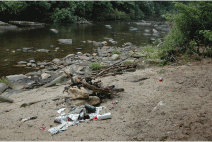
- The USFS should begin managing the upper Chattooga, and address the biophysical impacts of existing users.
- The Integrated Report found no basis for the historical 30+ year boating ban.
- The Integrated Report found no basis for future limits on paddling.
- The Integrated Report anticipates boating use being very low on the
- The only impact that the Integrated Report attributes to paddlers that is not shared equally by all users is a potential impact on the recreational experiences of a very few backcountry anglers on a very few days. The report finds that based on natural flows, anglers will see zero paddlers on at least 80% of days, and might see zero, one, or two groups of paddlers on all but a handful of the remaining days.
- Anglers will rarely if ever see paddlers and will naturally have a boater-free river well over 80% of the time. Flow preferences protect this experience – nature strikes the best possible compromise without the need for any limits to any users.
- Any reservation system for paddlers would unacceptably inhibit paddlers’ ability to enjoy the 17-35 optimal paddling days expected each year.
- The USFS should require an on-site self-issued permit for all recreational users in the
- The USFS should not manage public lands for extremely small groups of users professing zero-tolerance for other wilderness compliant users. Anglers will have a boater-free river for well over 80% of days – predictably – without any limits at all.