
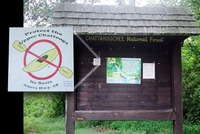
The South Carolina Council of Trout Unlimited had this to say:
“Small boat kayaking is an adventure sport, and by its very nature is at odds with the outstanding and remarkable values currently protected in the upper Chattooga.”
“[Allowing paddling on the Ellicott Rock section of the Chattooga] may in fact violate the principles of the Wilderness Act.”
The “Friends of the
“Like the pervasive motorized vehicles, the easier access resulting from kayaking again threatens the pursuits of backcountry enthusiast and the wilderness itself. Creek boating is considered an intrusive activity for the backcountry angler, wildlife viewer or hiker; Encounters would result in a diminished wilderness experience for these other visitors. Like mountain biking on land trails, it is time the USFS acknowledges and correctly classifies the differences between creekers and other river users.”
“The
Several recent comments claimed that allowing boating will lead to allowing All Terrain Vehicles, like the person who wrote this: “If you let boaters on the River above Hwy. 28 then the next step will be the ATV companies will sue to get ATV’s on hiking trails.” Other people have stressed the risks to children that boating poses. Check this one out: “If boating is permitted I could certainly envision many of the swimmers being involved in accidents where the kayakers drop into a pool full of children with inner-tubes.” Still others claim we trash rivers: "Boaters…could take large loads on their boats to potentially spread trash and human impact to areas far removed from the current public access points."
No matter where you live, if you love getting out in the backcountry in your canoe, kayak, or raft on any river, these recent comments made to the US Forest Service should make you cringe. Of course it is all absurd: paddling is one of the core uses protected by the Wilderness Act and the Wild and Scenic Rivers Act, ATV’s are inconsistent with those acts, paddlers don’t litter, and the likelihood of a paddler boofing onto a swimmer is too small to fathom. Regardless, the US Forest Service seems to be believing these people.
The USFS Scoping Document released several weeks ago proposes 5 alternatives that ban boating on part of the
If you believe in the right to float down a river, you should write the Forest Service and tell them so. Let them know that their alternatives for banning boating have no basis – and that they must allow boating on the
The USFS has asked the following questions and you should respond:
1. Should there be new standards limiting trailheads, trails and/or campsites? Yes, the current management has lead to unacceptable impacts. In addition, the USFS should monitor use by all users through a self-registration permitting system.
2. Should there be new standards limiting group sizes, encounters between user groups and/or access? Every river corridor has a certain capacity. If/when the USFS can demonstrate that the upper Chattooga’s capacity is met, all users’ access (not just boaters) should be limited consistent with sustainability of the resource.
3. Should there be new boating opportunities on the
4. Should there be new standards limiting group sizes, encounters between user groups and/or access if new boating opportunities are allowed? Restoration of boating access has nothing to do with this underlying question. This question is no different than #2 above, and the answer is no different either. Every river corridor has a certain capacity. If/when the USFS can demonstrate that the upper Chattooga’s capacity is met, all users’ access (not just boaters) should be limited consistent with sustainability of the resource.
Write the USFS today, and let them know that you cherish and respect your right to paddle through Wilderness Areas and on Wild and
Send your comments to the USFS project manager, John Cleeves, by SEPTEMBER 13th:
Via email: comments-southern-francismarion-sumter@fs.fed.us
Or via traditional mail:
Francis Marion &
Sumter National Forests