
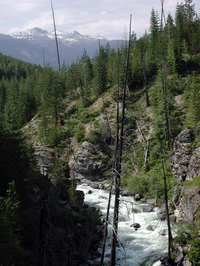
Paddlers are in the news this week, speaking out in support of protecting our nation’s remaining federally owned roadless lands. Paddlers Rebecca Giddens and Mark Singleton authored an editorial on roadless area protection that has been picked up by several large newspapers including the Sacramento Bee and the Salt Lake Tribune. Rebecca Giddens is co-owner of Kern River Brewing Company and is an Olympic silver medalist. Mark Singleton is the Executive Director of American Whitewater, and Chair of the Outdoor Alliance.
The editorial focuses on the recreational and ecological value of roadless lands, and an opportunity for their long term protection that is now under consideration by the US Congress. The Roadless Area Conservation Act of 2007 would legislatively protect the remaining federal roadless lands that President Clinton sought to protect with the embattled 2001 Roadless Area Conservation Rule. The Roadless Area Conservation Act is now under consideration by committees in both the US House and the US Senate.
You can view an online list of Senators supporting roadless area conservation and Representatives supporting roadless area conservation, and may like to reach out to your congressmen in support of this legislation. The text of the House and Senate versions of the Act can also be read online. For more information on protection of roadless lands and rivers, check out the project link in the box to the right of this article.
The editorial can be read at the websites for the Sacramento Bee or the Salt Lake Tribune, and can be read below:
Nation’s Roadless Rivers are in Serious Jeopardy
Paddling a river is an ancient activity – possibly the first human mode of transportation not involving putting one foot in front of the other. Yet while the world has grown since people first took to the water, there are still some places in our country where you can dip a paddle into a pristine river, feel the tug of the current and silently glide downstream. And thanks to the roadless areas found in our national forests, there are more such havens than most would expect.
Unfortunately, roadless areas occupy a legal netherworld where they are neither easily developed nor really protected. Even worse, efforts to weaken protections for these last undeveloped places, by the Washington allies of mining and logging interests, have put these regions in serious jeopardy. Leaders in Congress, however, have kicked off a renewed effort to protect such natural treasures once and for all.
Paddling along remote rivers and waterways – the original highways used to explore our great nation – offers a truly unique way to experience our national forests and some of the last vestiges of wild and unspoiled lands in America. Indeed, roadless areas are home to some of the most scenic and challenging whitewater paddling opportunities around, as well as family-friendly rivers and lakes.
Roadless areas, frequently at lower elevations than wilderness areas, provide accessible backcountry recreational opportunities for millions of Americans. For example, roadless areas in North Carolina’s Smoky Mountains, the White Mountains of New Hampshire and West Virginia’s Highlands provide world-class paddling opportunities. Out West, roadless areas preserve the water quality for headwater areas of the famous "River of No Return," Idaho’s Salmon River.
One of the premier rafting and kayaking rivers in the world, the Salmon River is not only a magnet for paddlers but home to 70 percent of all salmon and steelhead habitat in the entire Columbia River Basin. And in California, roadless areas in the Sequoia National Forest safeguard the headwaters of the Kern River – an important recreation spot for thousands of visitors each year and an invaluable source of clean drinking water for millions of Californians.
But the ability for future generations to enjoy the paddling, rafting, fishing and many other such backcountry recreational opportunities in these areas lies in serious jeopardy.
Over the last seven years, cynical partisan politics has taken priority over protecting our roadless forests. In California, despite promises to Gov. Arnold Schwarzenegger to halt new roadbuilding, the Forest Service recently announced new management plans for the Padres, Angeles, Cleveland and San Bernardino forests that would open the forests to new roadbuilding.
A similar story can be found in Idaho, where mining interests have employed loopholes to clear the way for phosphate exploration and mining, to devastating effect in roadless areas within the Caribou-Targhee National Forest. This project could replace once pristine backcountry with toxic settling ponds and strip mines – hardly a spot for a family trip down the river.
But now, members of Congress from both sides of the aisle are working together to ensure that America’s natural heritage will be preserved for future generations of paddlers, bikers, climbers, backcountry skiers and hikers.
This year, more than 140 members of Congress, Democrats and Republicans alike, joined together to introduce legislation that would provide permanent protection for 58.5 million acres of pristine forestland in 39 states. This bipartisan initiative in the House was joined by a companion measure in the Senate, introduced with the support of 18 original co-sponsors.
Constructing new roads in wild forests, where the very absence of roads is their defining resource value, doesn’t make sense.
Roughly 85 percent of all the revenue generated from our national forests comes from recreation activities. Yet, while a gym or city park can easily be rebuilt or repaired, once a roadless area is opened to logging, mining and road building, the damage can never be undone.
Responsible management of America’s natural heritage is a value that cuts across both sides of the political aisle and unites us in a shared legacy of stewardship. It’s time to protect these last vestiges of our nation’s past before it’s too late. The joy of paddling along a pristine river, far from any automobiles or other reminders of modern life in America, is an experience that we should not allow to become extinct.
By: Rebecca Giddens and Mark Singleton