
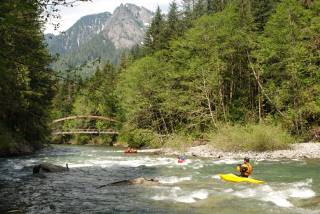
The following letter was mailed to the utility earlier this week in response to the Glen Park Project canal wall failure that happened in late October of this year. American Whitewater will work with other interested parties in New York, and the owner of the canal, to have the river restored to a condition that is similar to or preferable to the pre-collapse site conditions.
December 1, 2002
Mr. Mark Sundquist
Northbrook Energy
Glen Park Hydroelectric Project
Glen Park, NY
Re: Repair of the Glen Park Project Canal Wall Failure
Dear Mr. Sundquist:
On behalf of the memberships of American Whitewater and New York Rivers United and the outfitters who ply the whitewaters of the Black River Gorge near Watertown, we want to express our sympathy for the unfortunate situation the failure of Glen Park’s canal has put you and your company in. We also wish to express our appreciation for the opportunity you made available to meet with Northbrook staff at the Glen Park hydro plant on Monday, November 25, 2002. We particularly appreciate your candor, access to the site and availability of project information. We look forward to continued cooperation and collaboration in the months to come as your firm assesses and responds to the damage caused by the collapse of a portion of the project’s canal wall into the Black River October 28, 2002.
Paddlers and outfitters have had a close relationship with the Black River Gorge and your project since its inception. Contentious negotiations between the developer and paddling interests in the 1980s were resolved in a groundbreaking agreement for water releases, access, visitor amenities and landscaping with the previous owner that was accepted as part of the federal license that governs operation of this power plant. After the license issued, collaborative efforts have been continuing on a wide range of implementation matters on every one of these topics. It is in this spirit that we look forward to future discussions on the issues raised in this letter with respect to the catastrophic failure of the canal.
In general, we believe that the canal repair project must adhere to the highest standards of quality for recovery engineering and re-construction such that within one year, the area affected is returned to conditions in the Black River Gorge that are aesthetically and experientially consistent with or superior to pre-collapse conditions. We believe that with adequate funding, creativity, supervision and coordination and attention to detail, equipment and construction methods exist today to achieve this goal. There appear to be several process and activity issues that are critical to project success. The items below are submitted in good faith and should serve as a jumping off point for future discussions among us.
A. Northbrook, its engineers and contractors and the stakeholders must agree upon and assiduously adhere to repair precepts and re-construction practices with respect to
1) removal of debris from the river and shoreline such that the Cruncher rapid returns to whitewater characteristics that are consistent with past experiences that attracted and excited paddlers and raft customers as soon as flow conditions permit equipment access but no later than July 15, 2003,
2) structurely sound reconstruction of the wall itself (and adjacent wall sections) and reinforcement of other areas of the canal wall and floor that may be found unsound,
3) immediate and assiduous protection of existing vegetation not affected by the failure itself and necessary construction through visible barriers and markings,
4) authentic re-facing the gorge wall with native stone that mimics adjacent strata across the expanse of the retaining wall to be completed no later than the end of 2003,
5) development and implementation of a robust landscaping plan that returns the Gorge vegetation to a semblance of the pre-collapse conditions including re-establishment of cedars and shrubbery consistent with the precepts contained in the December 2, 1985 ARO-AWA Black River Recreational Releases Agreement and subsequent vegetative revitalization and site restoration implementation program and be phased such that substantial progress is achieved in 2003 and completion accomplished by the end of 2004,
6) appropriate arrangements with all stakeholders in the event that normal recreational uses of the Gorge are precluded or proscribed due to a failure to complete re-construction by early May of 2003,
7) provisions for a fund to cover expense of on-site stakeholder re-construction monitoring activities, arrangements for which will be completed by December 15, 2002.
B. Northbrook will take immediate actions to assure that:
1) communications among the stakeholders are timely and effective. Since the repair project is progressing almost continuously, all parties need to know what has, is and will be happening on the ground, what has been discovered in the investigations, what problems loom in the near future, who is doing what and when, what civil structure designs are being considered and other information necessary for consideration of actions that will impact the elements of A) above. E-mail and telephone messaging will be utilized for this purpose at a frequency not to exceed 5 day intervals,
2) provisions for physical access to the construction area for viewing of all mission critical elements of the repair will be made for stakeholder representatives,
3) access for on-site visits and monitoring by stakeholder representatives will not be abridged except for obvious safety issues.
4) bi-weekly meetings on-site will be scheduled among all stakeholders starting the second week of December to review project progress and conference calls arranged during other periods,
5) identify by name, telephone number and e-mail address all project staff and define each person’s responsibility and supervisor,
6) dissemination of schedules, agenda, attendee lists, location for meetings and time of conference calls to be held with government representatives. The stakeholders have identified Bruce Carpenter of NYRU and Chris Koll of American Whitewater as the primary contacts for the stakeholder group although other representatives of stakeholder groups will stand in as appropriate. Tom and Julie Vickery will coordinate on-site monitoring activities.
C) In a timely fashion so as to permit stakeholder comment, Northbrook will provide stakeholder respresentatives with both preliminary and final:
1) drawings of canal repair concepts developed by Kleinschmidt engineers and any other contractors or consultants involved in this effort,
2) geologic characterizations from Haley and Aldrich and other geotechnical consultants involved with assessment of the structure and character of all parts of the gorge walls and floor under scrutiny,
3) re-construction progress reports and contracts for and by Tuscarora Construction and other entities carrying out elements of this repair,
4) reports to and minutes of meetings with any stakeholders,
5) specifications, plans and schedules for all landscaping activities.
D. Two issues that require immediate Northbrook attention are:
1) We understand that Tuscarora Construction has already made arrangements to transfer the rock removed during repair to others. We request that you make arrangements with this company to stockpile sufficient rock of a quality appropriate for refacing the new retaining wall rather than permitting transfer of all rock to others. We estimate that the amount of rock involved could be as much as 2900 cubic yards (150 feet long, 75 feet high, 4 feet thick with 75% extra rock in case it is needed). This estimate does not include any rock needed for river level shoreline armor or other re-construction activities.
2) We strongly insist that any and all appropriate actions be taken to assure that blasting and subsequent re-construction activities do not displace or otherwise change any other part of the Gorge face rock or vegetation presently in place. To the extent that changes in the Gorge face must be made to facilitate proper re-construction, all stakeholders and on-site monitors must to apprised of the extent of, need for and degree and likelihood of such changes prior to the changes.
3) We insist that all responsibilities pursuant to agreements that we reach with respect to this repair project and ongoing implementation of other elements of the federal license and AWA/ARO agreement of December 1985 will be made know to and binding on any future owners.
Thank you for your consideration and response to this letter. We suggest that Northbrook host a conference call among stakeholders early this week to discuss the matters raised in this letter and resolve any questions you and we may have at that time.
Sincerely yours,
________________________
Bruce Carpenter
NYRU
CC.
Peter Skinner P.E. (AW & NYRU)
Bob Peterson (B.O.B Rafting)
Chris Koll (AW)
Tom & Julie Vickery (Whitewater Challengers)
Alex Atchie (ARO)
Steve Burns (ARO)
Gary Staab (ARO)
Mike Duggan (Hudson River Rafting)
Len Ollivett (NYS DEC)
Dave Bryson (US FWS)