Tatshenshini
2. Dalton Post to Alsek (Dry Bay)
Sep 20, 2022
Sep 20, 2022
Sep 20, 2022
Sep 20, 2022
Launched Aug 24 and took out Sept 5. Laid over almost every other day. Rained periodically almost every day. Temperature was relatively warm near the start, but quite cold as we got into the areas with lots of glaciers. We had bad upriver winds a few times but for relativel short periods. A party that caught up with us said they fought winds every day.
The rapids on the first day were really good quality and fun rapids. Rowing this river is a lot of work as you must continually avoid shallows and it is hard to read which way the current is taking you. The water is opaque with glacial silt and choppy from wind and current. It helps to stick a paddle down in the water to feel which way the current is moving past the raft.
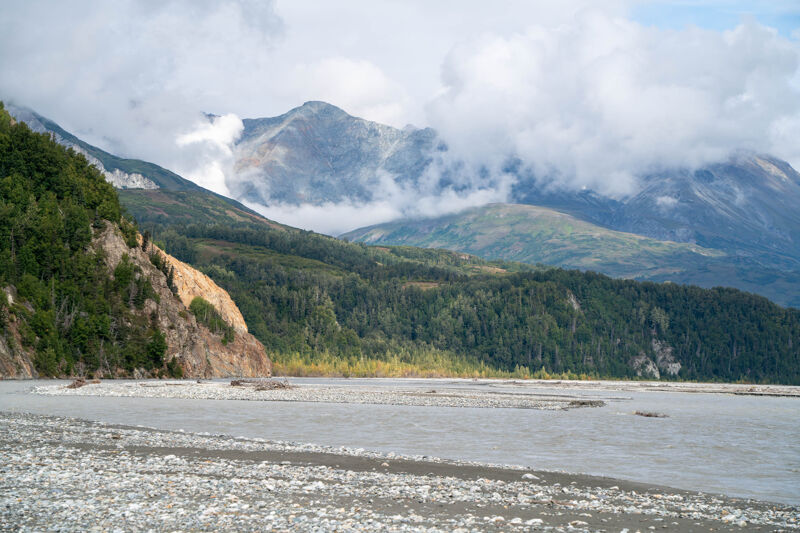
The scenery is spectacular, but hiking opportunities are somewhat limited by the thick woods and the fear of Grizzly bears. You need to hike in groups because of possibly running into a bear. There aren't many trails and going through the woods is slow, though interresting. There is a big variety of fungi to be seen.
Hiking up side streams is open, but involves endless gravel bar walking. Eventually you will have to cross braids and you may get blocked by channels too deep to safely cross. With the speed of the water, a six inch deep channel could be too dangerous to cross. I waded out a few places like that and nobody else was foolish enough to follow me. Since the water was opaque you don't know how deep it is until you put your foot down. Treking poles help a lot.
We saw Bear tracks and Moose tracks at all of our camps, but never saw moose. Saw one grizzley far across the river and that was close enough. Saw tracks of a solitary wolf at one camp. Saw beaver chewed logs everywhere but never saw beaver. I saw mouse like creatures at Alsek Lake and one other camp. We saw no other mammals at all. We saw Bald Eagles multiple times per day. We saw grouse and various other birds, including swans. We saw migrating Sandhill Cranes on our last day near Dry Bay.
Mar 13, 2014
Dalton Post to Dry Bay: Welcome to the food chain!
This Yukon put-in loaded with Grizzly and cold, fast glacial water. The rapid currents, glacial til-laden water and nice open country.
The day one canyon differs from every day on the Tatshenshini River.
The Tatshenshini-Alsek Park links the three adjacent national parks, Kluane in the Yukon, Glacier Bay and Wrangell-St Elias in Alaska, to create a 97,000 square kilometre ecological unit and bi-national World Heritage Site. Situated in the extremely rugged northwest corner of British Columbia, in 1993 it became the fourth component in the largest international protected area in the world. Half the landscape is permanently covered in snow and ice - the other half fosters forests and tundra and stable populations of wildlife untouched but for a historic aboriginal presence.
To ensure the preservation of the entire ecosystem, the Tatshenshini River and its tributary, the Alsek River, are completely protected from headwater to source, creating the only large river drainage in North America that is completely safeguarded.
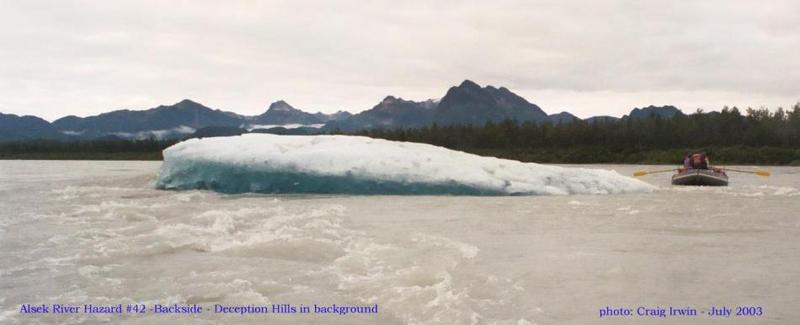
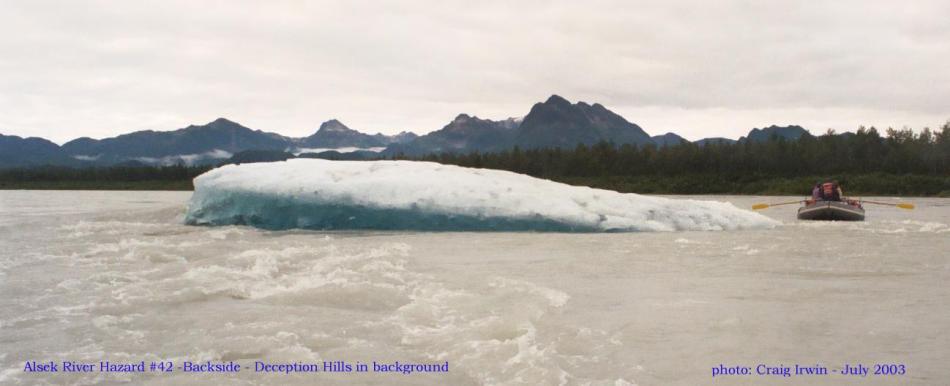
Unique river hazards when approaching Alsek Lake, commonly icebergs form river-wide dam/sieves, grounded icebergs become cave/sieves.
The heat and bugs in the upper reaches usually contrast the fog and glacial chill of the lower half of this mighty Wild river.
Jul 15, 2003
A beautiful battleship iceburg grounded in the Alsek River two miles downstream from Alsek Lake. Not a good thing to wrap on.