
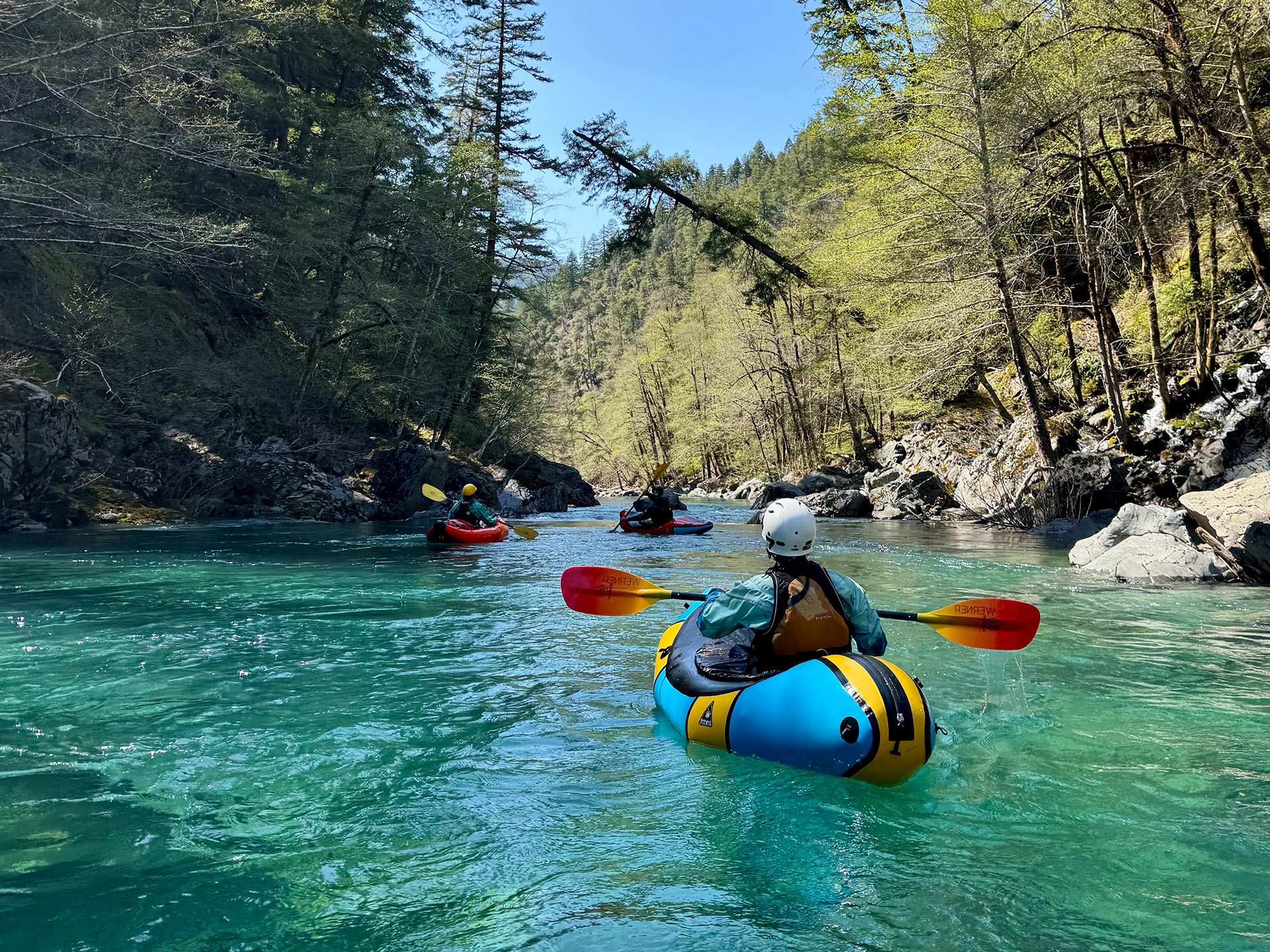
 The Siskiyou Mountains in Southwestern Oregon give rise to iconic wild rivers like the Wild and Scenic Illinois, Rogue, Chetco and North Fork Smith Rivers. The region is known for its stunningly clear rivers, salmon strongholds, unique and rich biodiversity, and outstanding opportunities for angling and backcountry whitewater adventures. Those exploring the headwaters of these rivers pack their boats and gear in through rugged wilderness terrain. A new generation of ultralight gear, including packrafts, has made it more feasible to explore the region but it is rugged country. Flows can be tricky to predict, and any trip is a true adventure. The mainstem rivers have easier access and have been known as whitewater classics for decades, and flow through some of the same rugged country.
The rivers and public lands of the region face persistent threats by proposals to develop nickel strip mines at Baldface Creek (tributary to the North Fork Smith River), Rough and Ready Creek (tributary to the Illinois River), and in the headwaters of Hunter Creek and the Pistol river on the Oregon Coast. The voice of the whitewater boating community is needed to protect the rivers of the region.
The Threat
Mining companies have actively pursued proposals to develop three nickel strip mines in the region. Red Flat Nickel Corporation–an international mining company–has proposed the “Cleopatra” strip mine in the Baldface Creek watershed, which is a key tributary to the Wild and Scenic North Fork Smith River. The company has also proposed a second strip mine in the headwaters of Hunter Creek and the Pistol River on the Oregon Coast. Similarly, RNR Resources has proposed a strip mine for nickel in the headwaters of the Wild and Scenic Illinois River on Rough and Ready Creek.
According to the U.S. Environmental Protection Agency, the metal mining industry is the largest source of toxic pollution disposal in the country. These rivers are unique with relatively undeveloped shorelines and remain in a free flowing condition from their headwaters to the ocean. The damage and pollution caused by strip mining are irreversible, and if these mines move forward, they would destroy the very things that make these rivers—and this region—so special.
In addition to the impacts to whitewater recreation, a strip mine would pose a serious threat to local drinking water supplies. Test drilling alone has significant potential to contaminate and impair the public drinking water of downstream communities. In particular, towns in Del Norte County, CA including Gasquet, Hiouchi, and Crescent City receive their drinking water from the Smith River, and many are on record opposing the mine proposed near Baldface Creek. The rivers of the region are also strongholds for chinook and coho salmon and steelhead. A strip mine would have significant impacts to these values.
Although some of the area’s values have been protected through numerous designations (including the Kalmiopsis Wilderness and Wild and Scenic River designations, the Smith River National Recreation Area in CA, Outstanding Resource Waters designation through the Clean Water Act for the North Fork Smith, Roadless Area Conservation Rule protections, and an administrative mineral withdrawal from new mining claims for a 20 year period), they are not enough to fully protect this remote and rugged landscape from the threat of mining. The 1872 Mining Law prioritizes mining activities over all others, making it difficult for public lands agencies to protect drinking water supplies, salmon strongholds, and vibrant recreation economies.
American Whitewater’s Stewardship
American Whitewater has worked with our partners to protect the wild Kalmiopsis rivers from the threats of nickel strip mines through a number of advocacy efforts including the following:
- Opposing Red Flat Nickel Corp’s application for a water right from the Oregon Water Resources Department for exploratory drilling in 2014.
- Designating the Cheto River, from the Steel Bridge within the Rogue River-Siskiyou National Forest and to Alfred A. Loeb State Park. as a State Scenic Waterway in 2016.
-
Securing administrative protections for a period of 20 years to prevent future mining activity by securing a “mineral withdrawal” through Public Land Order No. 7859; Withdrawal of National Forest System and Bureau of Land Management Public Lands in Southwestern Oregon; Oregon; 92 FR 4415-4416 (Issued Jan. 13, 2017). Contrary to how it sounds, a “mineral withdrawal” means withdrawing public lands from new mining activity rather than withdrawing minerals from the land.
-
Supporting the Oregon Department of Environmental Quality and California State Water Resources Control Board in designating the North Fork Smith River and its tributaries as Outstanding Resource Waters under the Clean Water Act in July 2017.
- Supporting the efforts of Senator Wyden and Representative Hoyle to secure a permanent mineral withdrawal through federal legislation.
- Supporting Oregon Department of Environmental Quality in designating the Illinois River, including all direct tributaries from the National Forest boundary downstream to Lawson Creek, and all of Rough and Ready Creek as Outstanding Resources Waters under the Clean Water Act.