
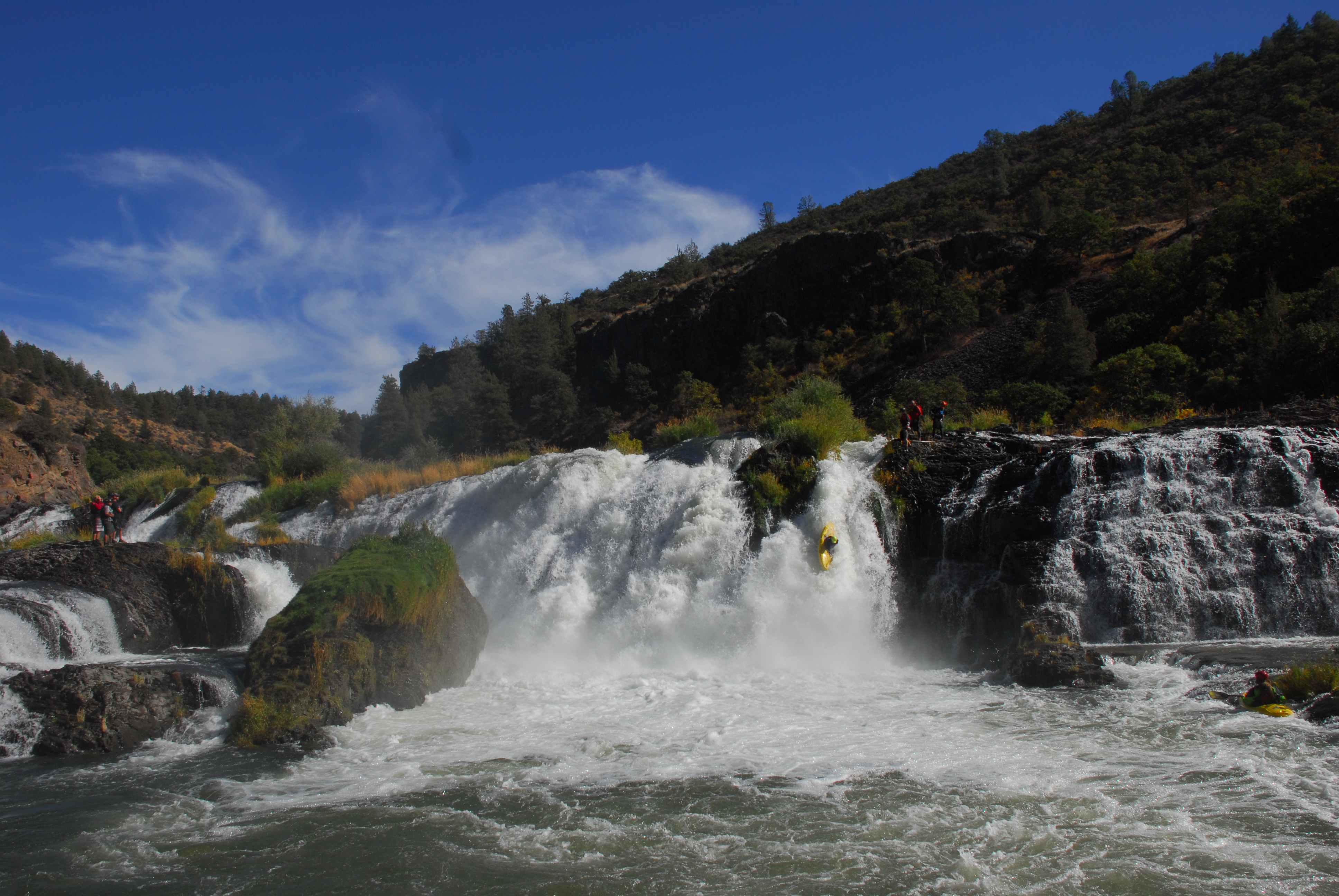
The Pit River is the largest river in northeastern California; its watershed is 4,324 square miles. The Pit flows in a southwesterly direction through valleys and basalt canyons before being inundated by Lake Shasta, where the confluence with its main tributary, the McCloud River and the Pit’s confluence with the Sacramento River are also submerged. With its ultimate headwater point near Lakeview, Oregon, the Pit’s waters find their way to the Pacific Ocean at the Golden Gate of San Francisco Bay.
The Pacific Gas & Electric (PG&E) has extensively dammed and diverted the Pit River with multiple, stacked hydropower projects. The Pit projects are numbered by their age and upstream to downstream. The most upstream project, Pit 1, began construction in 1920. From 1923 to 1926, licenses were issued to construct Pit 3 and Pit 4 developments (there is no Pit 2 project). In 1942, PG&E renewed its license for Pit 3 and Pit 4 and also received authorization to construct Pit 5. Pit 6 and 7 are downriver, and the waters from the McCloud River are diverted to the Pit watershed to generate power.
As far as whitewater goes, what isn’t beneath reservoirs is typically deterred by the dams and diversion of PG&E’s Pit 1 (FERC P-2687) and Pit 3, 4, and 5 (FERC P-233) hydropower projects. Each of these projects includes at least one dam, a tunnel that carries diverted water out of the river, and a powerhouse – where power is generated and the water is returned to the Pit River. In the Pit 3, 4, and 5 developments, all of the tunnels are just over four miles long. This re-plumbing of the Pit River channels water around a combined 30 miles of natural riverbed that, when not dewatered, has excellent whitewater. If not for PG&E’s hydropower projects, the Pit River would flow with ample whitewater year-round–a unique river in California.
When PG&E’s Pit 1 operating license expired in 1995, it had few environmental requirements. The Pit 1 forebay, only 12 to 15 feet deep, fluctuated as much as 3 feet per day in response to power demand. No minimum flows were required in any project reaches, leaving over eight miles of the Fall and Pit Rivers dewatered and river flows downstream from the powerhouse were highly variable.
As required by the new Pit 1 license issued in 2003, PG&E releases steady flow into the Pit River Canyon, and new release rates for the powerhouse slowed unpredictable fluctuations and curbed streamside erosion downstream. Punctuated flushing flows control unwanted vegetation from encroaching into the river channel and serve a dual benefit as a special whitewater release in the summer, and fall whitewater flows were implemented in 2011. For the first eighty years, the project had operated with no flow requirements. Since 2003, thanks to the new license, there is more balance.
When the Pit 3, 4, and 5 license was set to expire, PG&E adopted a new strategy: convene negotiations and create an agreement to settle principal issues. Convened in 1998, the Pit River Collaborative Team (PRCT) produced a settlement in 2003 that forms the framework of a new 2007 license. The license term – 36 years – is set to end at the same time as the Pit 1 license, for maximum coordination of the Pit River.
Several interests directed the licensing agreement. Bring water back into 22.5 miles of the Pit at slower naturalized rates. Enhance the top trout fishery in the Pit and in Hat Creek. Ensure that recreational resources – including fishing, whitewater, and the Pacific Crest Trail – were protected.
The PRCT agreement established new minimum flows at double or more the previous minimums. It also prescribed seasonal variation and a 0.5 foot-per-hour rate of change in releasing the flows, to mimic a natural hydrograph. These renewed flows and key habitat enhancements such as gravel replenishment and transporting wood downstream from the reservoirs will improve conditions for fish and wildlife. To be sure, PG&E will monitor aquatic life and water quality extensively over the life of the license, guiding adaptive management decisions for the river.
Through the settlement talks, key parties also resolved protection of the Hat Creek Wild Trout Management Area. Established in 1969, the Area is the first state-designated Wild Trout Creek. At the base of its 3.5 mile length, the state constructed a barrier dam to prevent the warmwater fishery of Lake Britton from invading the prized coldwater trout fishery [pictured at right]. A separate 2003 agreement, partially incorporated into the license, commits PG&E to funding 50% of the costs to maintain the barrier dam, and to providing $300,000 toward stewardship management over the next 30 years.