Lusk Creek
Lusk Creek Canyon (8.1 miles)
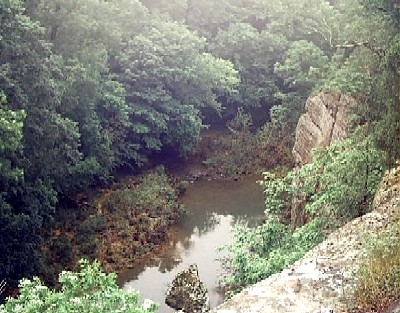
April 4, 2018
| Reporter | Timothy Bauer |
I'd like to spend a little time touching upon some comments made by others while offering my own two cents.
As already warned, Lusk Creek can double or triple in height in hours. Conversely, the creek drains about as fast as it crests. Even in just a moderate light rain, I saw it rise from 4’/150 cfs to 8’/1600 cfs overnight on 3/29/2018 and then drop down to 4.5’/300 cfs by the following afternoon on 3/30/2018! Catching it at a sweet spot that’s neither dangerously high nor disappointingly low will be a mix of luck and lust (or “Lusk”). At high levels with pushy current there will be genuinely dangerous obstacles and difficult-to-nonexistent portaging. And accesses off the creek and out of the wilderness forest are very limited, via arduous trails, and far from any main roads.
I paddled this probably somewhere in the 250 cfs range, as it was dropping at the time. I recognize that for serious whitewater paddlers this is an almost laughably low level. However, it's plenty paddleable at this stage. Sure, there will be some scraping in the shallows and fords, and nothing rises about Class II. But it's still really fun and breathtakingly beautiful.
The thing is, at high levels, all manner of huge debris will be whisked downstream and inevitably lodged against the larger boulders. Immediately upstream of the Saltpeter Cave ford crossing is a big, long log pinned against a boulder on the left that juts to the right in a right-hand bend. In other words, the current pushes you toward the log pretty formidably. Skilled paddlers should know how to dodge such an obstacle, but it bears mentioning that the higher the creek, the greater the number of such dangers.
Also worth mentioning are two sets of double boulders to watch out for -- the first upstream of the canyon, the second immediately downstream from the canyon. The first is preceded by a 2-3' chute right above the rocks. In other words, at the base of the rapids one has to pivot a full, hard 90-degree turn to the left (where the current flows) to avoid being swept into and pinned against the rocks. The second set, mentioned above as a recommended portage, does collect a ton of trees and debris, but there was plenty of open water on the right to thread through without having to portage -- at least at low levels. Nonetheless, it's prudent to keep these in mind and anticipate them beforehand.